
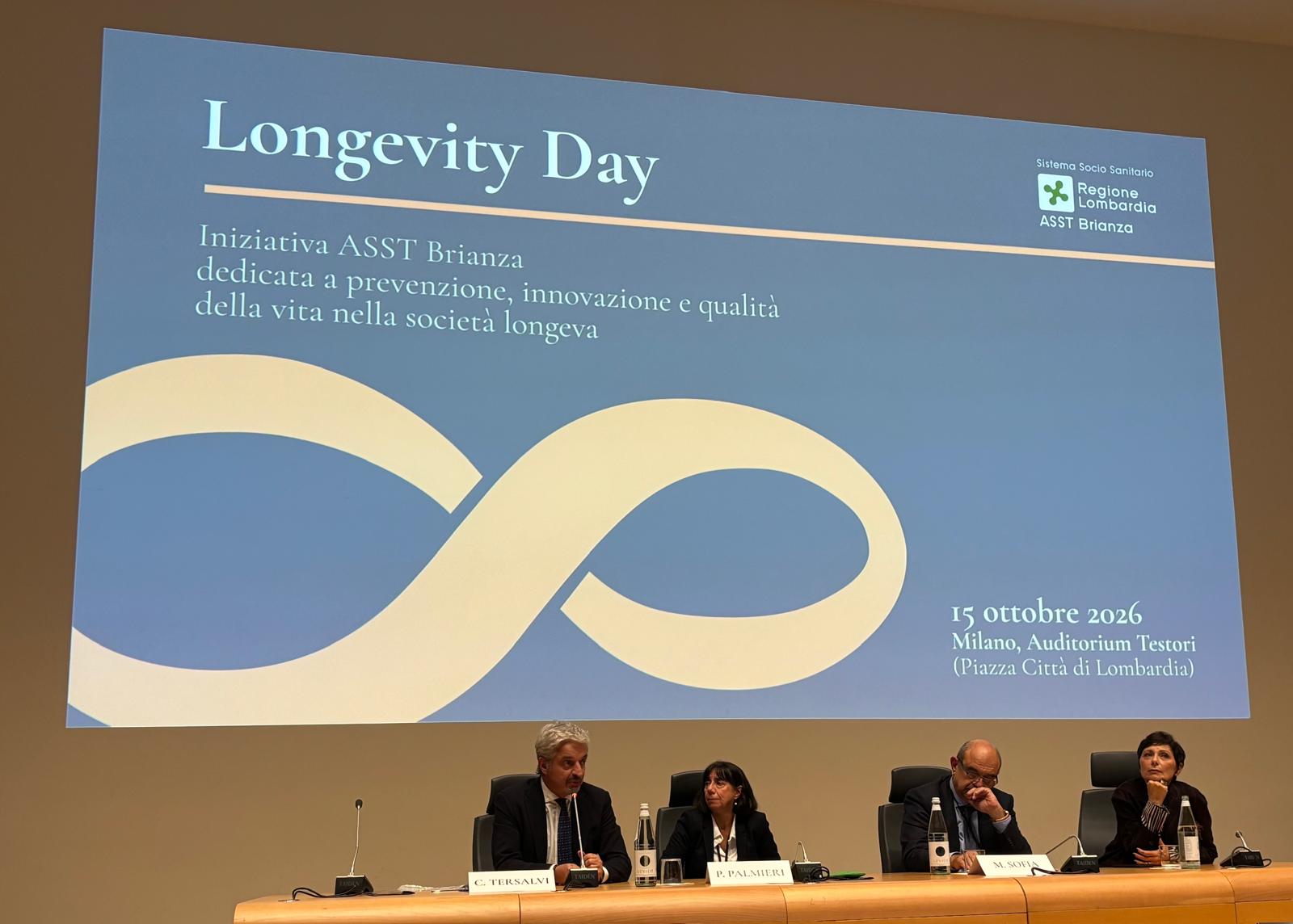
From the gap between lifespan and healthspan to the rise of dependency, and the role of artificial intelligence and age-friendly cities. It is not enough to live longer: the real challenge is to increase the years lived in good health and with autonomy. This was the message at Longevity Day, promoted by ASST Brianza with Michele Sofia as scientific director, Tiziana Fraterrigo and Salvatore Verzì on the scientific committee, hosted on October 15 at the Auditorium Testori in Palazzo Lombardia, which brought together representatives of institutions, healthcare professionals, academics and welfare experts to discuss the prospects of a longer-living society.
The Conference
To open the conference, Michele Sofia, the medical director of ASST Brianza, began by saying that longevity is first and foremost a system-wide challenge. Federico Romani, president of the Lombardy Regional Council, started by noting that beyond research, innovation and AI, healthcare must always stay close to people, and that kindness should be a guiding principle because, yes, it is important to add years to life, but also serenity. Mario Melazzini, director-general of welfare for the Lombardy region, reiterated the importance of predictive capacity to identify individuals who could prevent chronic conditions.
Following, the keynote lecture by Giuseppe Bellelli, professor of geriatrics at the University of Milano-Bicocca and director of the Geriatrics Unit at the IRCCS San Gerardo dei Tintori Foundation, drew attention to the persistent gap between life expectancy and healthy life expectancy. He noted that in the G7 countries, the difference remains about ten years. In this context, interventions aimed at preserving the so-called “intrinsic capacity” of a person and prevention models promoted by the WHO, such as the ICOPE program, become particularly relevant, having already been piloted in Lombardy.
On the institutional panel participated Emanuele Monti, Lombardy regional councilor, and Fabrizio Sala, a member of the Chamber of Deputies, focusing on national and regional longevity policies.
The issue of the sustainability of care systems was addressed by Lorenzo Mantovani of the University of Milano-Bicocca, who approached the longevity discourse from a demographic perspective, emphasizing that an aging population requires ever more careful management of care complexity, distinguishing between care interventions, prevention, and continuous support for frail individuals.
Particularly relevant was the analysis by Francesco Longo of CERGAS SDA Bocconi on dependency. In Italy, over-65s who are not self-sufficient number about 4 million, equivalent to 28.4% of the elderly population, and over 2.6 million do not receive any caregiving services. This highlights the need to strengthen the integration between healthcare, social services, and support for family caregivers.
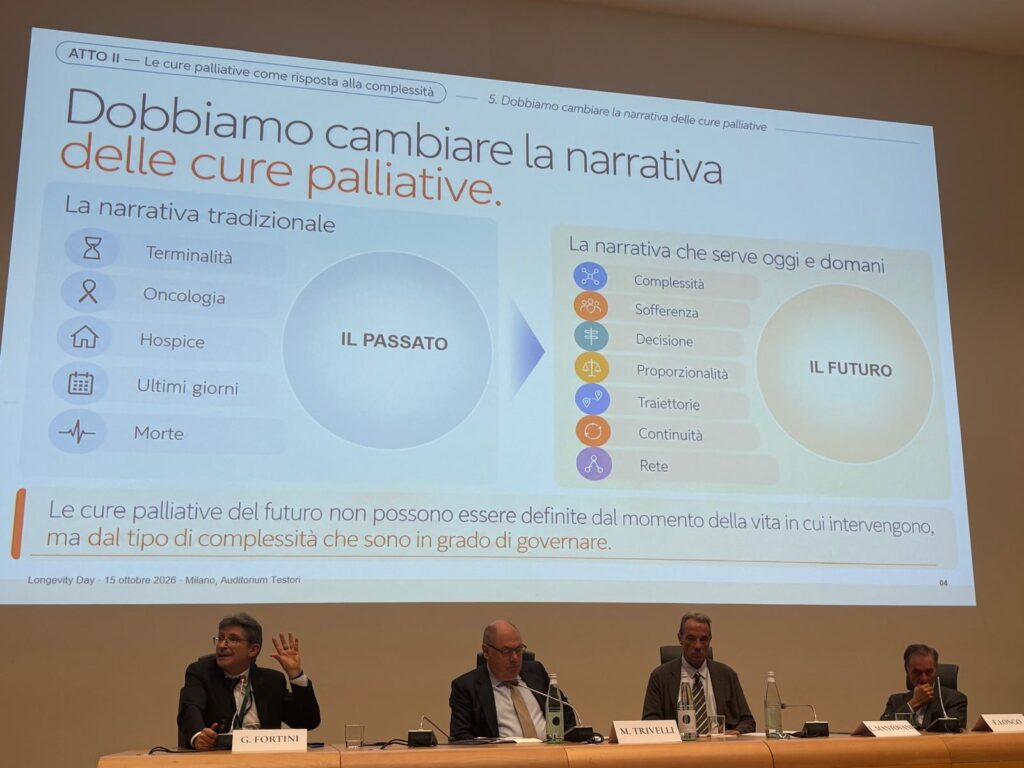
There was also talk of palliative care. Gianpaolo Fortini, president of the Italian Society of Palliative Care, emphasized the importance of moving beyond the association of palliative care with end-of-life, instead recognizing its role in managing clinical trajectories characterized by chronicity and complex frailty.
In coming on a Brussels flight, Mario Mantovani, a member of the European Parliament, illustrated European policies, reiterating the idea that policies are needed to support all stages of life. The morning ended with Elena Lucchini, Lombardy regional government’s family assessor, outlining projects for active longevity.
In the afternoon, the discussion broadened to the social and organizational aspects of longevity. According to projections presented by the Politecnico di Milano, by 2050 almost one in three Lombards will be aged 65 or older. Hence the need to develop cities and services that are more accessible, rethinking mobility, housing and senior living models.
There was also room for the contribution of digital technologies. Stefano Denicolai, from the University of Pavia, highlighted the opportunities offered by artificial intelligence to sustain an increasingly aging society, but warned about the risk of inequalities tied to digital skills and the uneven diffusion of technological tools.
On the long-term care front, Cinzia Di Novi, president of the Italian Association of Health Economics (AIES), presented European data showing how unmet care needs are associated with a decline in cognitive health and greater social isolation among the elderly, with a significant impact on caregiver well-being as well.
Participants in the health-focused roundtable “Longevity as a System Challenge” included Michele Brait, general director of IRCCS San Gerardo dei Tintori, Federica Rolli, director of social and health services ATS Città Metropolitana di Milano, and Carlo Tersalvi, general director of ASST Brianza.
At the close of the conference, linking from Palo Alto, Marco Quarta, a biotech researcher, presented the outlook of scientific research on new molecules that promote healthspan.
From the various talks emerged a shared vision: longevity represents an opportunity for society only if accompanied by effective prevention strategies, integrated pathways between hospital and territory, support for families, and inclusive use of new technologies. In this scenario, public health service organizations are called to play a central role in promoting healthy aging and coordinating care networks.
Subscribe to Karla Miller