
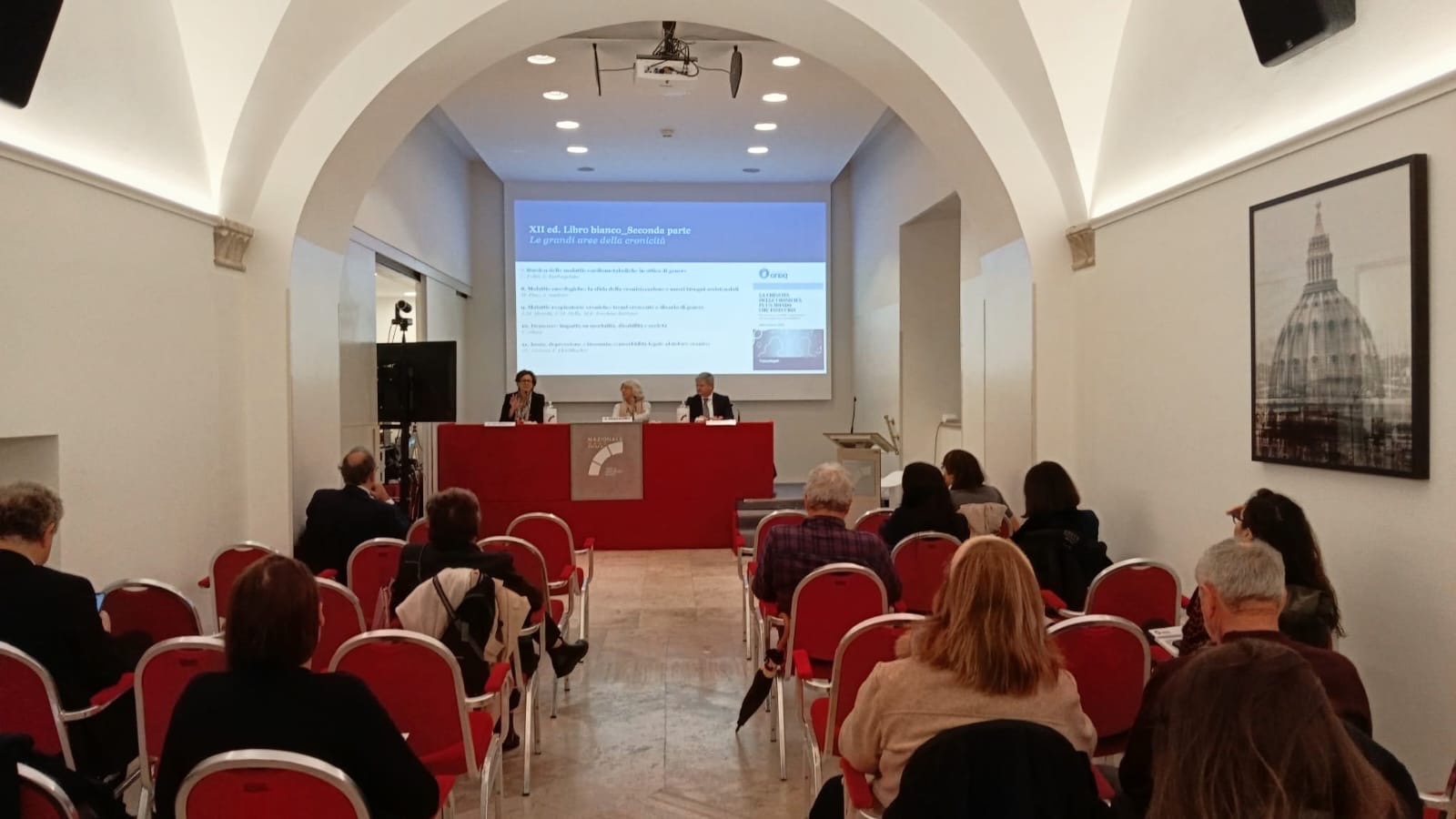
Overcoming a fragmented health system that remains siloed and still oriented toward single diseases to build a model of continuous, multidisciplinary care that is truly integrated across hospital, community, and home. This is the trajectory outlined by the XII White Paper from Fondazione Onda ETS, titled: “The growth of chronic conditions in an aging world. Toward new organizational models between innovation and sustainability”, presented in Rome on November 19.
The Numbers Behind a Country in Deep Transformation
The numbers offer a portrait of a transition that can no longer be postponed. People over 65 in our country already account for 25.1% of the population (ISTAT 2026) and 12.8 million individuals live with at least two chronic conditions. More than 7 million have functional limitations, a condition affecting more than one in three people aged 65 and older (35.4%). At the European level, non-communicable chronic diseases account for roughly 80% of the overall disease burden and drain 70% of health care spending.
“Today a person with multiple chronic diseases risks having to manage visits, specialists, medications and tests on their own, often without a professional coordinating their care journey,” observed Francesca Merzagora, president of Fondazione Onda, urging a dedicated contact point after discharge, home-based services linked to hospitals, periodically re-evaluated therapies, and greater resources to prevent complications before they require new hospitalizations. “It is a necessary transformation: the Italian National Health Service (SSN) must be organized around people’s needs, not ask people to adapt to its organization.”
This request primarily aims at greater investments in prevention, today stuck at 5% of total health funding, along with early diagnoses and innovation. In line with this, Nicoletta Orthmann, the medical-scientific director of Fondazione Onda, underscored the need to strengthen territorial health care by integrating general practice, specialist services, and proximity facilities within a multidisciplinary care-coordination vision.
The Essential Linkage of Care Settings to Ensure Continuity of Care
It was precisely the connection between care settings—hospital and community—that was at the center of Andrea Montagnani’s intervention, president of FADOI – Federation of Italian Hospital Internists. He highlighted a persistent organizational gap between hospital care and community care, clarifying that we should not pit hospital against territory, but govern the handoff. From the hospital specialist, the patient must be entrusted to the general practitioner for follow-up, preventing breaks in continuity of care, flare-ups, and avoidable hospital admissions.
A step change was also called for by Hon. Gian Antonio Girelli of the XII Commission on Social Affairs, who urged valuing geriatrics, its social dimension, and the fight against loneliness.
Gender Medicine, Caregivers, and the Six Guiding Directives of the White Paper
The debate also highlighted the dimension of gender medicine, historically central to Fondazione Onda’s work. In a video message, Senator Beatrice Lorenzin (V Budget Committee) called for recognizing gender differences in the quality of care and for building a new pact across generations.
On the caregiving front, Angela Ruocco, scientific head of the gender-medicine reference center at the Istituto Superiore di Sanità, highlighted the “hidden cost” of caregiving and its impact on life expectancy. While public policies often focus on the direct health-care costs, the lack of dedicated registries and structured measurement tools leaves this labor largely invisible, even though it is weight-bearing—especially for women of the so-called “sandwich generation” (45–65 years), pressed between caring for parents and caring for children, and called to balance caregiving with family life.
These points converge in the six directives of the volume to translate the change into concrete actions: increase investments in prevention (above the 5% threshold), adopt a single care plan for the chronically complex patient, appoint a care manager at discharge and provide coordinated home care, implement periodic medication reviews, strengthen territorial teams with interoperable digital tools (such as telemedicine and remote monitoring), and assess the quality of care—including avoidable hospitalizations, equity, gender differences, and support for caregivers.
On the industrial side, Carlo Riccini, general director of Farmindustria, highlighted the modernization progress of the Report over its twelve-year life, underscoring the central role of research and pharmaceutical innovation in offering new treatment prospects, meeting current and future needs, and ensuring equity for younger generations.
Subscribe to Integrative Medicine