
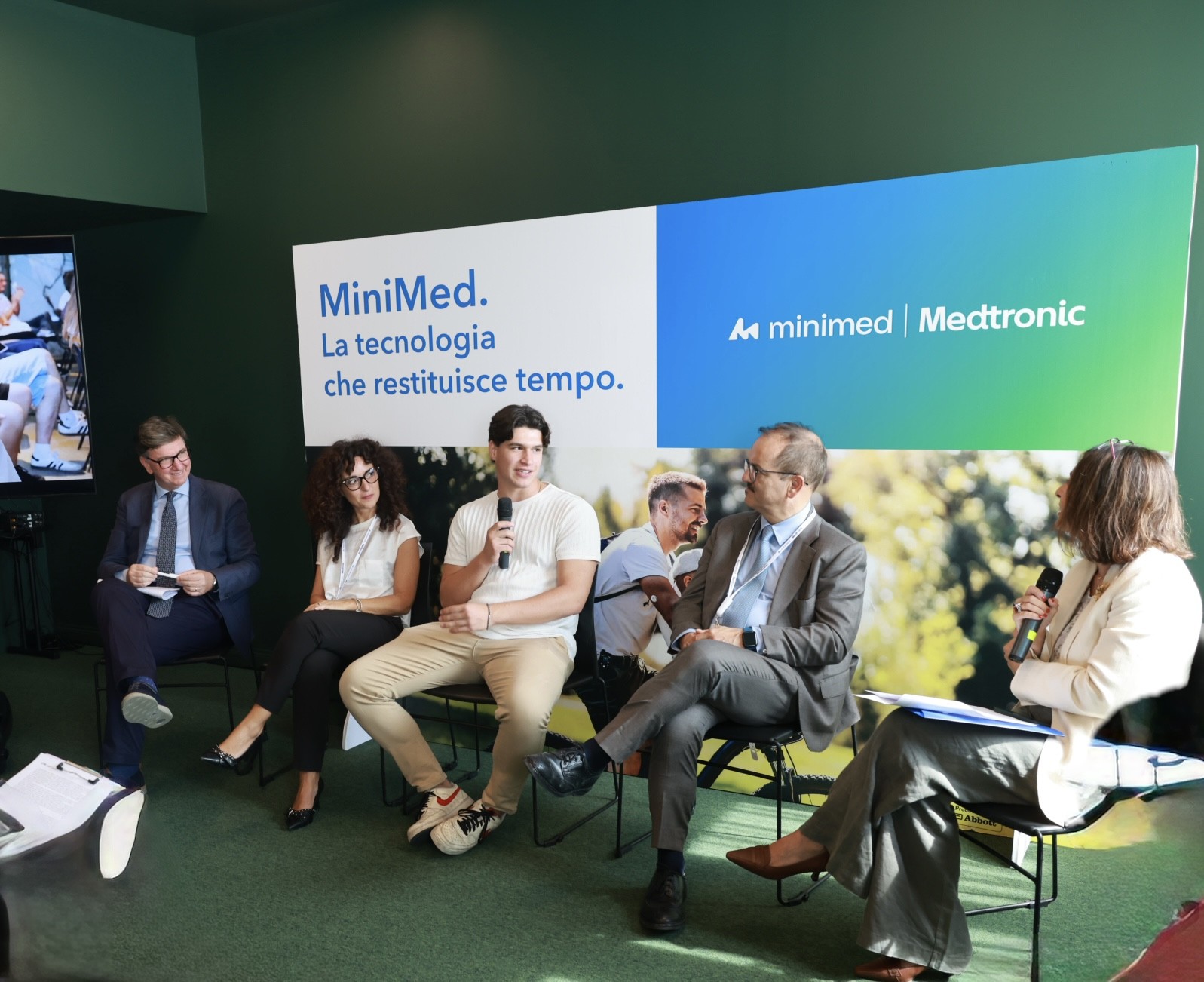
Technology is significantly reshaping the everyday management of diabetes. More reliable systems capable of anticipating the needs of people with diabetes are helping to reduce the mental burden of the condition and improve quality of life. In this context, the mission of MiniMed Medtronic, a company active in insulin-delivery solutions, comes into focus as it recently unveiled its latest innovations.
The news centers on the MiniMed™ 780G system integrated with the Instinct sensor and the MiniMed Go™ system integrated with the Instinct Go sensor: two solutions designed to simplify daily diabetes management and enhance the user experience through varying levels of automation and decision-support. Instinct and Instinct Go are small CGM sensors with a compact, discreet design, easy to use and comfortable to wear for up to 15 days.
“Real innovation returns time to people. With our latest MiniMed technologies we aim to make diabetes management simpler, more automated, and more personalized, so people can spend less time thinking about diabetes and more time living,” said Luigi Morgese, Senior Business Director, Medtronic Diabetes (MiniMed).
MiniMed 780G and Instinct: better monitoring and management
For the roughly 300,000 Italians living with type 1 diabetes, accurately counting carbohydrates and administering insulin up to 15 minutes before meals can be a challenge. Doses delivered late, forgotten, or underestimated raise the risk of postprandial glucose spikes. Thanks to the SmartGuard™ algorithm, the MiniMed™ 780G system delivers an advanced level of automation in insulin delivery, with the aim of reducing the daily burden of diabetes management.
Clinical evidence suggests that the MiniMed 780G system may help people with type 1 diabetes achieve more consistent glycemic control, surpassing the ADA guideline targets, which set a Time in Range (TIR) of 70% as the reference value. With optimal settings, many users reach a TIR of 80% and a nocturnal TIR of 91%.
The MiniMed 780G system is in fact the only system equipped with Meal Detection™ technology, designed to reduce post-prandial glycemic peaks in cases where the user occasionally forgets a bolus or underestimates carbohydrate intake.
MiniMed Go™ and Instinct Go for Multidose Daily Injections (MDI) therapy
For people on multidose daily injections (MDI), diabetes management often remains fragmented across non-connected tools and requires ongoing mental calculations in daily life.
The MiniMed Go™ system is the first solution to combine in a single platform real-time data from continuous glucose monitoring with dose-tracking for the smart insulin pen InPen™, offering practical support for daily therapy management.
The platform also tackles one of the main adherence challenges faced by people using MDI: via a single mobile app, it provides real-time alerts and practical guidance when a dose is missed or when glucose rises, helping users manage diabetes with a lighter daily burden.
MiniMed Go, already compatible with the Simplera™ sensor, which has a wear duration of up to 7 days, is now also available with the Instinct Go sensor, which can be worn for up to 15 days.
For Riccardo Candido, president of the AMD Foundation, “Multi-injection therapy remains the everyday reality for many people with diabetes. It is therefore important that those using this therapeutic approach have access to technologies that integrate glucose monitoring with insulin administration, facilitating more timely and informed therapeutic decisions and helping reduce the daily burden of disease management. Integrating continuous glucose monitoring with digital tools to support therapy can foster better glycemic control, including Time in Range, and simpler and more informed diabetes management. Expanding access to effective and appropriate technologies is therefore a key element in improving the quality of care and the quality of life for people with diabetes.”
The access challenge
The described solutions reaffirm the role of research and technology in making type 1 diabetes management easier. Alongside the clinical and practical potential of these tools, there are nonetheless some barriers to their full adoption in clinical practice and care pathways.
“Among the main factors slowing adoption are regional heterogeneity in prescription and procurement procedures, and more generally the fragmentation of the national health system,” adds Candido. “In this context, the device risks being viewed primarily as an immediate cost, rather than an investment capable of delivering clinical benefits and, over time, economic gains. If improvements in glycemic control and quality of life can be seen in the short term, the benefits related to reducing complications and related healthcare costs tend to emerge in the medium-to-long term, over 3-4 years. A further challenge is the misalignment between rapid technological innovation and the timelines of regional procurement processes, which can stretch beyond two years, risking that technology has evolved by the time it becomes actually available.”
The hope is that these innovations can help bring the person with diabetes back to the center of the care pathway, restoring quality time and promoting simpler, more conscious and sustainable management of the condition.
Sources:
1. Data on file, Abbott Diabetes Care, Inc.
2. Among patient-applied sensors.
3. Report to the Parliament on Diabetes 2024 – Status of knowledge and new developments in diabetes mellitus
4. MiniMed™ 780G System User Guide.
5. American Diabetes Association. Glycemic Targets: Standards of Medical Care in Diabetes 2022. Diabetes Care. 2022;45(Suppl.1):S83-S96.
6. Choudhary P, et al. Diabetes Technol Ther. 2024;26(Suppl.3):S32-S37.
7. McVean J, et al. Diabetes Obes Metab. 2026;28(3):2456-2460.
8. Sherr JL. Impact of the MiniMed AHCL system on post-prandial glucose after a missed meal bolus in adolescents and adults with type 1 diabetes (T1D). 10th Annual Diabetes Technology Meeting; 2020. doi:10.1177/1932296821996093
9. Laurenzi et al., Diabet Med. 2025 Dec;42(12):e70161. doi:10.1111/dme.70161.