
Early recognition of frailty, planning discharge before returning home, and ensuring continuous care management in the community. These are among the goals of the four operational documents that Italian geriatrics propose to address the challenges of elderly care, from hospital admission to home and residential facilities. A pathway that also involves primary care physicians, called to collaborate with geriatricians, nurses, community services, and caregivers.
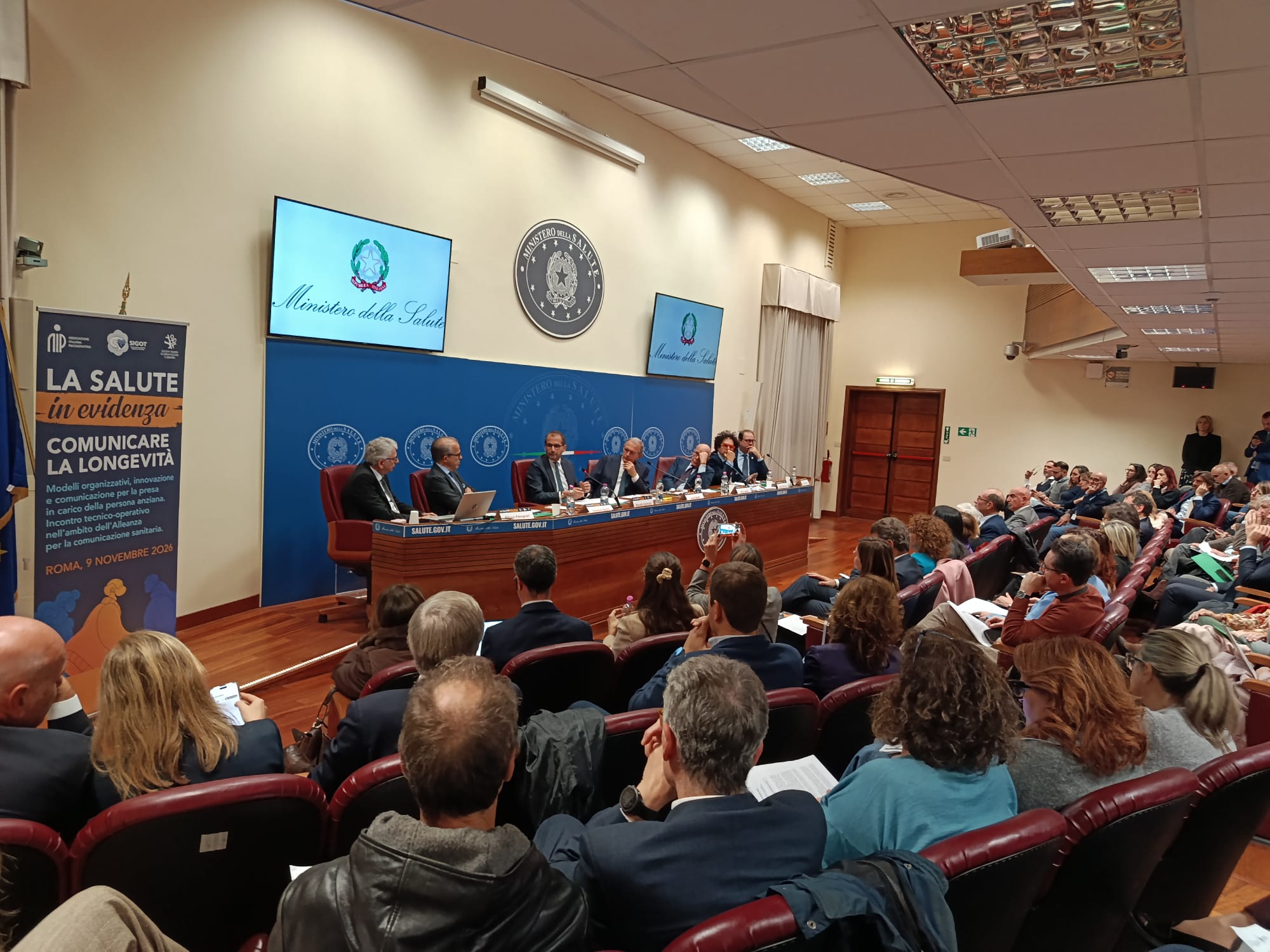
These proposals were presented to the Ministry of Health during the event “Health in Focus – Communicating Longevity”, promoted jointly by the Italian Society of Hospital and Community Geriatrics (SIGOT), the Italian Society of Gerontology and Geriatrics (SIGG), and the Italian Psychogeriatrics Association (AIP) with Giovanni Migliore, the Ministry of Health’s Director General for Communications. The aim is to provide institutions with the experience of professionals who daily assist fragile elderly people, outlining concrete solutions to prevent interruptions in care, avoidable hospitalizations, and loss of autonomy.
Frailty and care needs: over 5 million seniors need help
According to the 2026 Censis report, 36.6% of Italians aged 65 and older report needing some help with daily life, even though they consider themselves independent: a percentage that has roughly doubled since 2006, when it stood at 18.3%.
Applied to ISTAT’s count of 14.8 million people aged 65 and over, this equates to about 5.4 million individuals. A picture complemented by data from the PASSI d’Argento surveillance program of the Italian National Institute of Health: in 2023–2024, 16% of the elderly are in a frail condition, while 14% have a disability. Distinct conditions that underscore how important it is to organize care around the person’s actual needs before daily difficulties translate into loss of independence.
Frail seniors in the hospital: early screening and planned discharges
The first document proposes identifying at‑risk elderly patients early, right at the Emergency Department, using rapid frailty assessment tools. In more complex cases, the geriatrician should work alongside other specialists in managing the hospital stay, helping to prevent complications, functional decline, and loss of autonomy.
Discharge planning is also central, and it should begin during the hospital stay and include coordination with community services before returning home.
Home-based care: bridging primary care, geriatrics, and community services
The second document aims to move beyond home care made up of uncoordinated, one-off services. It proposes continuous care management, with an individualized plan, defined responsibilities, and collaboration among primary care physicians (PCPs), geriatricians, nurses, community services, and caregivers.
Among the tools are telemedicine, tele-rehabilitation, and, in selected patients, hospital-at-home programs. Care must be adaptable quickly when clinical conditions worsen, avoiding hospitalizations whenever possible.
Nursing homes and residential care: care proportionate to the elderly’s needs
The third document addresses the wide regional differences in residential care offerings. The proposal is to classify facilities based on the actual care provided, defining common quality criteria and levels of care intensity matched to needs.
Beyond traditional nursing homes, intermediate options are valued such as assisted living, co-housing, and respite stays for families. A residence should not necessarily be a final destination: when possible, the pathway should also allow a return to home.
Geriatric multidimensional assessment and Individualized Care Plan
The fourth document proposes a shared pathway to recognize frailty and define the required care. After an initial screening, the Geriatric Multidimensional Assessment delves into clinical conditions, autonomy, cognitive abilities, and social circumstances where appropriate. The result should translate into an Individualized Care Plan with interventions, responsibilities, and timelines for re-evaluation. The information already available should accompany the patient through transitions between hospital, home, and residential facilities, avoiding duplication and unnecessary repeated assessments.
Continuity of care: the geriatrics’ contribution
“The frail elderly often has multiple illnesses, takes multiple medications, and presents clinical, functional, and social needs that cannot be addressed in isolation,” stressed Luca Cipriani, President of SIGOT. “With these documents we aim to help overcome the fragmentation of care, valuing the role of geriatrics across different care settings. The goal is not to create new parallel structures, but to make existing ones more effective through shared pathways, appropriate assessments, and real continuity between hospital and community. We must prevent a hospitalization from translating into loss of autonomy or a discharge that leaves the patient and family without a point of contact.”
“A primary need is to translate scientific evidence into organizational models that are truly implementable, capable of guaranteeing care continuity and comprehensive management of the aging person,” emphasized Prof. Dario Leosco, President of SIGG.
Psychogeriatrics: prevention, cognitive capacity, and social isolation
«The hallmark of the AIP is interdisciplinarity: geriatricians, neurologists, psychiatrists, and psychologists work together to integrate their expertise and address the cognitive, behavioral, psychological, and social aspects of aging — notes Carlo Serrati, incoming president of AIP — We are therefore committed to building shared pathways capable of intervening in behavioral disorders, preserving cognitive abilities, and countering isolation. Prevention plays a central role in this approach, as demonstrated by the PREVE.D.I. project, dedicated to preventing stroke and dementia through early identification of risk factors and targeted interventions. These are two conditions that profoundly affect an older adult’s independence, and it is important to act before they lead to disabling consequences. Aging, however, does not necessarily mean decline, nor should aging be treated as a disease. Our goal is to preserve identity, dignity, and life continuity for the person, without reducing them to their illnesses, highlighting remaining abilities and fighting loneliness and social isolation».
Caring for the elderly: a global, personalized assessment
«The geriatric approach goes beyond treating individual diseases; it requires a global assessment of the elderly person. Its specificity lies in the ability to grasp the complexity arising from overlapping and interacting deficits across multiple health domains, to provide integrated and personalized care» says Giuseppe Bellelli, incoming president of SIGG and Professor of Internal Medicine and Geriatrics at the University of Milan-Bicocca.
The proposals to the Ministry of Health: topics of the discussion
The meeting brought together representatives from government, health-system management, and scientific societies. After the institutional greetings from Hon. Marcello Gemmato, Undersecretary of Health, and the introduction by SIGOT president Luca Cipriani, contributions followed on the GRACE and Hypoxia Day studies, palliative care, psychogeriatrics, and home hospitalization models, with talks moderated by Dario Leosco, SIGG president, featuring Filippo Fimognari, SIGOT honorary president; Giuseppe Bellelli, SIGG president-elect; Carlo Serrati, AIP president-elect; Virginia Boccardi, SIGOT vice president; Andrea Ungar, past president of SIGG.
The four documents were presented by Lorenzo Palleschi, former SIGOT president; Andrea Fabbo, SIGOT scientific director; Marco Trabucchi, former AIP president; Giuseppe Bellelli, in a session moderated by Luca Cipriani and Giuseppe Quintavalle, president of FIASO.
There was also room for health communications and prevention, with Giovanni Migliore, Director General of Health Ministry Communications; Massimo Andreoni, Italian High Council of Health; Caterina Rizzo, Professor of Hygiene and Public Health, University of Pisa. Coordinating the proceedings was science journalist Daniel Della Seta.
Abbonati a Karla Miller