
Meditation, an ancient practice, is enjoying a genuine “second youth” thanks to the unprecedented attention of the international scientific community. Today, sitting quietly is no longer regarded as merely a spiritual act, but as a powerful health-promoting tool and a strategic resource to support long-term care pathways and prevention.
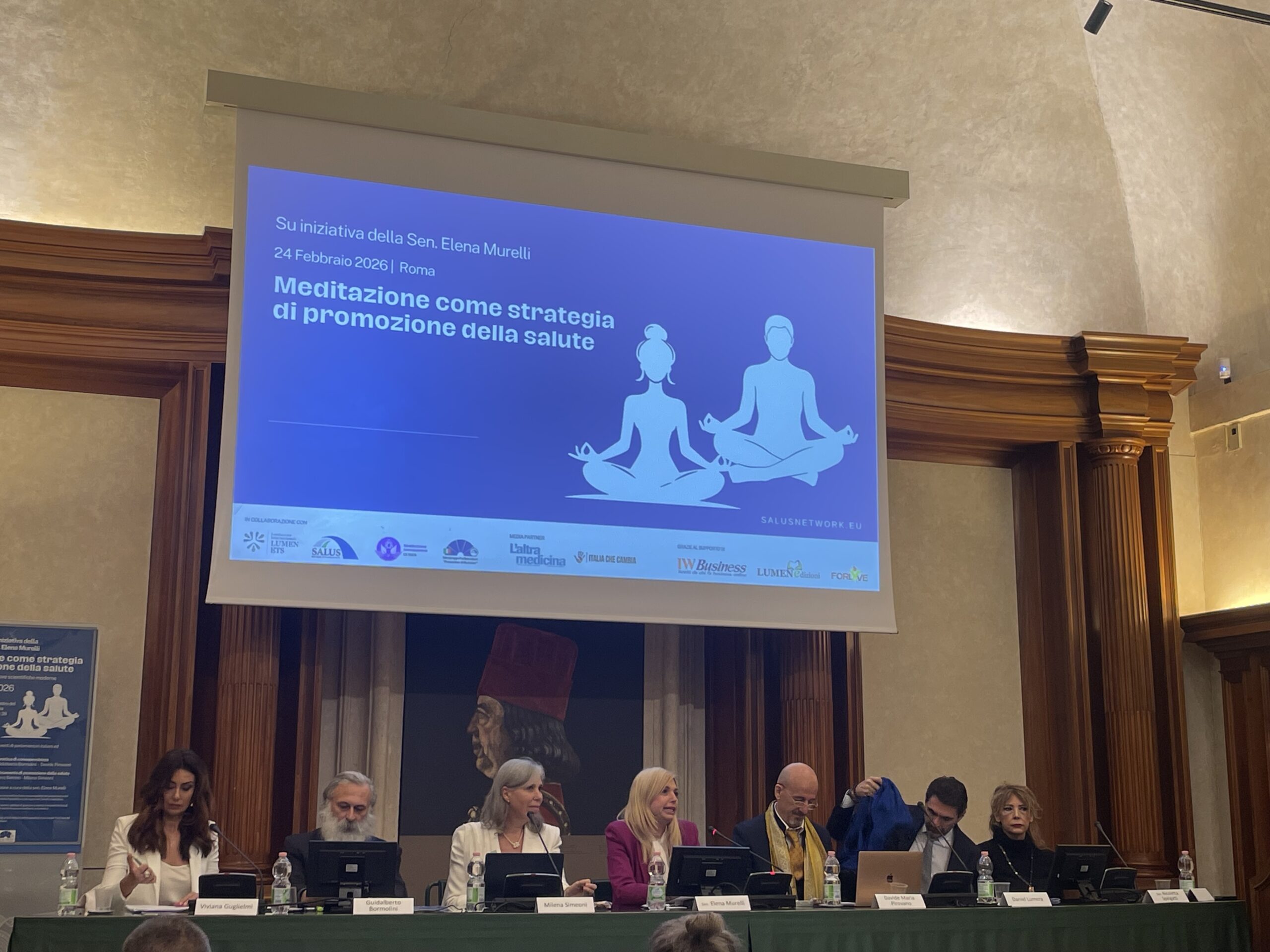
It is precisely at this fascinating meeting point between ancestral knowledge and modern scientific evidence that the conference concentrated its focus. The event was hosted in the institutional setting of the Senate, in the Sala Capitolare within the Cloister of the Convent of Santa Maria Sopra Minerva, on February 24 in Rome, under the title “Meditation as a Strategy for Health Promotion.”
The initiative, organized by the International LUMEN Foundation ETS with the support of the SALUS Network and promoted by Senator Elena Murelli, President of the Intergroup “Promotion of Health,” brought meditation into the spotlight as part of mind-body interventions.
A Practice That Improves Physical and Mental Health
The evidence gathered over the last decades is compelling: consistent practice contributes to a drastic reduction in systemic inflammation and in the perception of pain, while effectively addressing anxiety, depression, and fatigue. In addition to psychological benefits, research documents tangible improvements in cognitive performance, concentration, and sleep quality, with meaningful results even in complex clinical settings and among vulnerable populations.
The meeting thus proposed a multidisciplinary and cross-cutting view of meditation. No longer just a route to self-knowledge and personal growth, but a cost‑effective health intervention, easily reproducible and capable of triggering a real paradigm shift toward a medicine that centers patient awareness as the engine of healthy and sustainable longevity.
At the opening, Senator Elena Murelli, president of the Intergroup, recalled how the journey began from the encounter with the International LUMEN Foundation and the European SALUS Initiative. “Today we open the doors of the Senate to meditation to officially recognize it as one of the pillars of primary prevention,” the Senator stated.
It isn’t just theory: Murelli stressed the importance of meditation for maintaining balance and clarity in the complexity of political and daily life. “Giving ourselves time to breathe consciously helps us regain centering and clarity, fostering more thoughtful and responsible decisions.” The political objective is to look at international experiences, such as in the United Kingdom, where mindfulness is included in NICE guidelines for depression treatment, or in Germany, where health insurance covers its costs. “Starting from these examples, we can recognize this practice in Italy as well, overcoming the prejudices that still see it only as a trend or a purely religious dimension.”
The Systemic Vision: Beyond a Single Symptom
Milena Simeoni, president of LUMEN and founder of SALUS, delved into the scientific dimension of this approach. “Meditation is not an intervention aimed at a single symptom, but a practice capable of acting transversally on the overall regulation of the individual.” According to Simeoni, integrating meditation into health promotion strategies across the lifespan can improve population health indicators, reducing the burden of disease and, consequently, ensuring the economic sustainability of the NHS.
Meditation as an Example of “Democracy”: Daniel Lumera’s Analysis
During the morning, one of the most noteworthy contributions came from Daniel Lumera, biologist and naturalist, research fellow in the sociology of cultural processes and communication, author, lecturer, and international reference in the field of well-being, quality of life, and meditation practice. He described the practice as “one of the highest forms of democracy.”
Lumera presented data from projects developed in 23 Italian prisons, in hospitals (particularly in Switzerland) and in schools (especially in Spain), contexts in which the practice acts as an effective antidote to bullying and fragmentation of attention.
We live in an era in which the average attention span has fallen to just 47 seconds. “We are immersed in an inflammatory context born of hyper-stimulation that mainly affects young people,” Lumera reminded us, citing the doubling of antidepressant use among adolescents over the past decade, as highlighted by the latest AIFA report on drug use in Italy.
Meditation acts as a biological counterbalance: meditating is not just mindfulness, prayer, breathing, or visualization, but a process in which we can observe the brain’s imaginative constructs with a certain detachment, approaching happiness, joy, and fullness. Benefits also in terms of longevity are supported by clinical studies showing that after two and a half months of practice, the production of telomerase—the enzyme of longevity—increases by 30%.
Lumera then highlighted the importance of meditation in accompanying cancer care pathways and in palliative care, sharing a particularly impactful experience in this regard.
Epigenetics and Longevity Biology: Franco Berrino’s Perspective
The biochemical link between mind and body was further explored by Franco Berrino, medical epidemiologist and nutritionist. For decades it was thought that our fate was written in our DNA; today epigenetics teaches us that we can “turn on” or “turn off” genes through our actions.
“Meditation is able to activate DNA methylation mechanisms,” Berrino explained. “Inflammation-related genes like NF-kB are ‘silenced’ during practice, while immune defenses are activated.”
The reduction of silent inflammation is fundamental to counteracting all the pathologies that characterize our era: cancer, heart attack, obesity, for example. The entire environment around us influences epigenetics, starting with the food we eat. Meditation also acts on the genes of “reward,” the dopaminergic ones activated by drugs.
Moreover, today, as molecular biology can determine our age, studies on smokers have shown that their biological age is higher than their chronological age; a study conducted on monks, by contrast, revealed that for every year spent meditating, the brain gains about three months of “biological youth.”
A Triad for a Healthy Life: Nutrition, Lifestyles, and Meditation
The final invitation that emerged from the conference is to integrate meditation into a health triad alongside a healthy diet and physical activity, transforming individual awareness into a collective resource for healthy aging.
Subscribe to Karla Miller