
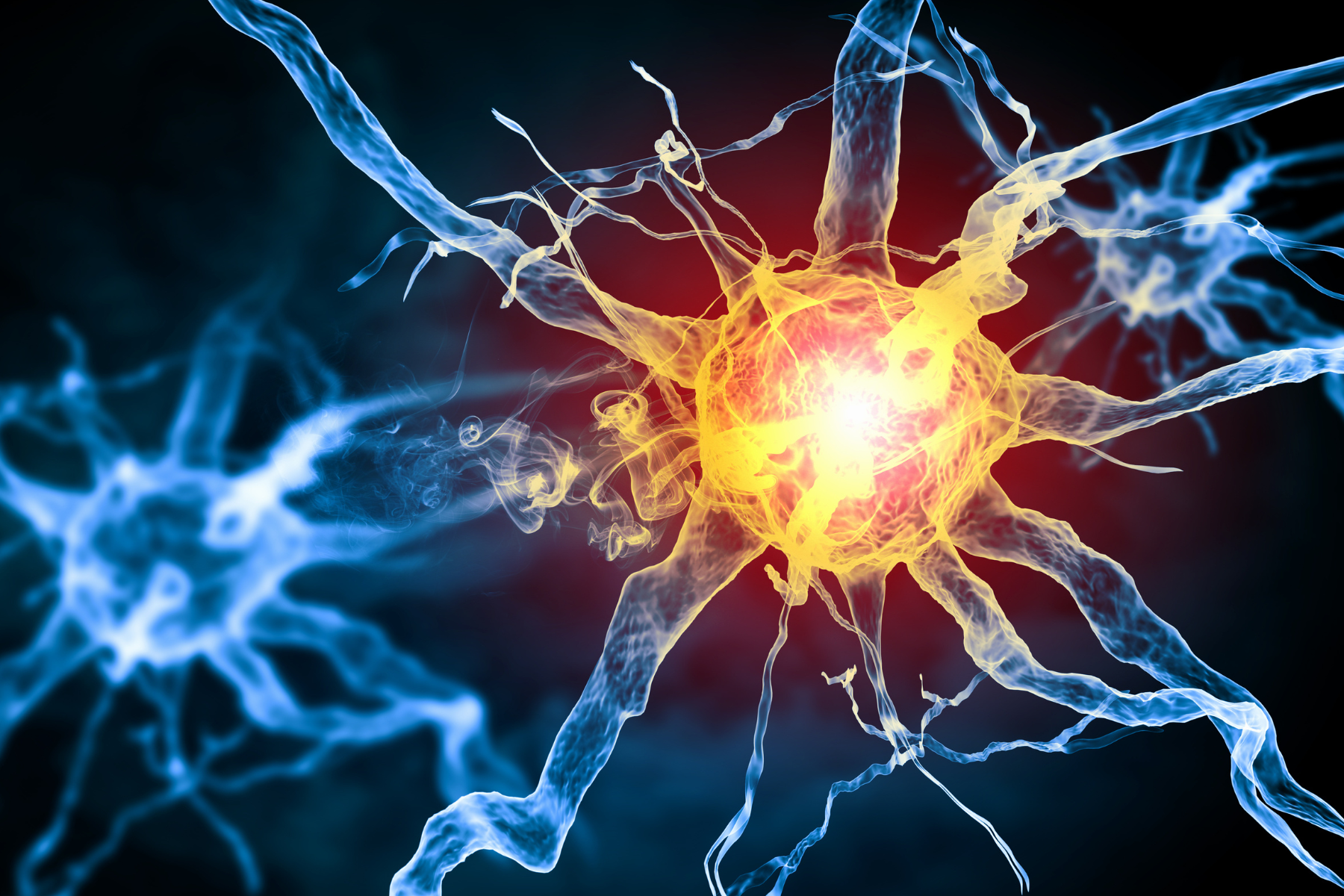
A mouse-model study from Washington University School of Medicine in St. Louis, published in Current Biology, indicates that mu-opioid receptors of the locus coeruleus may limit a circuit involved in neuropathic pain after nerve injury.
From Pain as a Warning Signal to Neuropathic Pain
Pain is a warning signal that, under physiological conditions, tends to fade when the underlying cause disappears. In neuropathic pain, caused by damage to the nervous system, the mechanism does not work properly: burning, stabbing, shocks, and exaggerated responses to touch or heat can persist even after the initial stimulus has ended.
The Study and the Role of Noradrenergic Neurons
The researchers studied mice in which a nerve injury reproduced experimentally neuropathic pain. Using optogenetic techniques, they briefly reduced the activity of cells in the locus coeruleus, largely noradrenergic neurons, and then measured responses to stimuli.
The result showed a reversal of function: once neuropathic pain was established, reducing the activity of those neurons diminished hypersensitivity. The locus coeruleus, known also for its analgesic action, was thus found to contribute to fueling the pain signal; the authors call it a pain generator.
Mu-Opioid Receptors: the Possible Local Brake on the Circuit
The researchers focused on mu-opioid receptors (MOR), abundantly present on neurons of the locus coeruleus and activated by both endogenous opioids and drugs such as morphine and fentanyl. In this circuit, MOR appear to act as a local brake.
In mice with nerve injury, selective removal of MOR from the neurons of the locus coeruleus increased hypersensitivity to touch and heat; restoring them in the same cells reduced it. The finding suggests that these receptors act as a brake on the brain circuit that sustains neuropathic pain.
Therapeutic Implications
The discovery opens a potential therapeutic avenue. Traditional opioids activate μ receptors across many areas of the brain and body, with possible drawbacks such as tolerance, respiratory depression, and risk of dependence. A more targeted intervention on the locus coeruleus could preserve part of the analgesic effect while reducing some of the downsides of generalized activation.
From Preclinical Data to Human Confirmation
But this is not yet a new cure. The experiments were conducted in mice, and it remains to be shown how closely the mechanism aligns with humans, as well as how to reach receptors so specific without interfering with other functions of the locus coeruleus. For now, a potential switch has been identified; it remains to be determined whether it can be precisely actuated in humans.
Study
Kuo CC, Norris MR, Dunn SS, et al. Mu opioid receptors gate the locus coeruleus pain generator. Curr Biol. Published online August 17, 2026. doi:10.1016/j.cub.2026.07.048
Abbonati a Karla Miller