
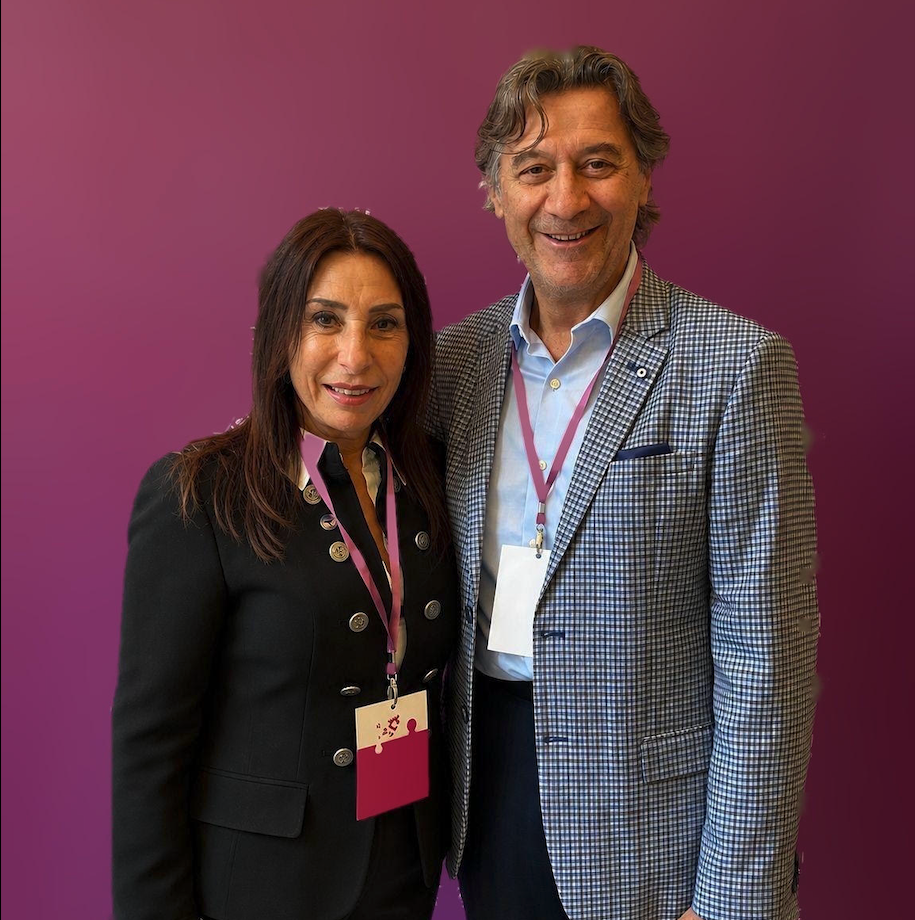
Food is a complex language. It has a molecular alphabet, a grammar built from timing, dosages, and combinations, and as many readers as there are systems in the body: genes, microbiota, the immune system, hormonal axes, and the brain. The same message, in different people, is not interpreted in the same way. This is the perspective developed by «Food as Medicine · Signal · Connection», the AIMF Health international congress held in October at Spazio Nutrizione in Milan, preceded on the 16th by a session on biohacking.
The scientific director is Ida Ferrara, president of the Italian Association of Functional Medicine; the event saw the official partnership with the Institute for Functional Medicine, IFM. At the heart of the program were her talk on multi-omics nutrition and the lectio magistralis by Alessio Fasano of Harvard Medical School and Massachusetts General Hospital: two contributions linked by the need to understand how diet, environment, and individual characteristics interact within the person’s biological network.
The words of the title define the path. Signal indicates how the body reads food: which systems receive the signal, with what sensitivity, and at what moment. Connection describes the passage of that message between systems and its translation into a personalized clinical decision.
From Nutrition to Reading the Systems
With «Multi-Omic Nutrition: Beyond the Diseased organ, toward the reprogramming of biological systems», Ferrara outlined the methodological frame of the congress. The clinical question extends from the affected organ to dysregulated systems and the reasons for their alteration. Genomics, epigenomics, metabolomics and microbiomics, read together, help describe this network in the individual and guide the nutritional intervention.
The patient is thus considered through their history, rhythms, exposures, and the relationships among biological functions. Nutrition becomes a tool to intervene on regulatory mechanisms within an assessment that links molecular information to the individual clinical conditions. The program developed this approach by following the dietary signal: from the systems that receive it to the context that modifies its effects, up to the tools used by the professional.
This perspective also developed in the dialogue between Ferrara and Manuel Salvadori, a biology-nutritionist and co-director of AIMF Health, on precision tools and clinical biohacking. Body composition, phase angle, heart rate variability, indicators of biological age, and metabolic monitoring deliver many measures. Their value, however, depends on the clinical question, the person’s history, and the ability to influence the professional’s decisions.
In the framework illustrated by Ferrara, data must be integrated into the reading of the patient. The proposed pathway includes clinical hypotheses, validated markers, personalization, and re-evaluation. A theme foreshadowed in Friday’s session, devoted to the prospects of the biologist, the physician, and the pharmacist: different skills called to work around the same person.
The Lectio magistralis
The scientific heart of the congress was the lectio magistralis, “L’asse microbiota–immunità–ospite: dai metaboliti batterici alla modulazione dei pathway autoimmuni sistemici.” Fasano traced the relationship between diet, intestinal permeability, and immune response, starting from celiac disease and the discovery of zonulin, the protein involved in regulating the intestinal barrier.
From gliadin to zonulin, the model shown links genetic predisposition, environmental exposures, barrier alteration, dysbiosis, and loss of immune tolerance. The disease is read through the interaction of these factors, within a system where host characteristics and environmental stimuli influence each other.
In this framework food also acts through the metabolites produced by gut bacteria. Short-chain fatty acids, including butyrate, and derivatives of tryptophan participate in dialogue with the epithelium and immune cells, contributing to the regulation of inflammatory processes and tolerance. The intestine emerges as the site of digestion, barrier function, and translation of dietary signals into biological responses.
A central passage concerned the longitudinal CDGEMM and GEMMA studies, dedicated respectively to celiac disease and autism spectrum disorders. Observing at-risk children from the earliest life stages allows studying changes in the microbiota, metabolic pathways, and metabolites that can precede clinical manifestation.
The interest of this reading lies in the possibility of watching the evolution of biological processes over time, trying to recognize alterations before they become clinically evident. The aim is to better understand the early stages of pathological processes and identify potential intervention windows. Barrier function and microbiota modulation thus become research domains for preventive and therapeutic strategies.
It is the link with Ferrara’s approach: reading the connections between systems to guide individualized interventions, distinguishing research perspectives from applications already validated. The lectio offered a key to interpreting the entire congress, showing how the dietary signal can be followed along the relationships between bacterial metabolism, the intestinal barrier, and the immune response. “The work of Prof. Fasano – explains the AIMF Health president – delivers a finding that changes the way we view disease: in the CDGEMM and GEMMA studies the microbiota and its metabolites change up to eighteen months before clinical onset. The disease was already written, not in the organ but in the network. It’s exactly the question functional medicine poses to every patient: not only what is altered, but why and since when. That is why, at AIMF Health, every datum, even the most sophisticated, goes into the functional clinical chart – first the life line, then Chronos, then Holos – because an omics datum without a history is just a number. Food is information: a single dietary molecule can open a biological doorway, and others can help keep it closed. Learning to read the network before it becomes disease is the task this congress has entrusted to all of us».
Immunity, Brain and Biological Clocks
Around these two contributions the program developed. Carlo Maggio deepened immunometabolism: the differentiation of T lymphocytes accompanies different metabolic programs, on which nutrients and metabolites act through nodes such as mTOR and AMPK.
Fausto Bellabona, Valentina Zipoli and Nicoletta Rebaudengo addressed neuroinflammation, microglia, and the vagal axis, linking intestinal signals, metabolism, and the nervous system. Stefania Cataldo introduced the temporal dimension with chrononutrition, chronobiology, and the allostatic load of the hypothalamic–pituitary–adrenal axis: meal composition, timing, and the conditions of the recipient matter.
Xevi Verdaguer discussed geroscience and longevity through modulation of mTORC1, mitophagy, and nutritionally derived senolytics. Alessio Rungatscher drew attention to metabolic flexibility, the ability to use carbohydrates and fats according to availability and energy demand.
The environment entered the discussion with Tiziana Notari and Luigi Montano, from the EcoFoodFertility group, through micro- and nanoplastics, endocrine disruptors, and possible repercussions on the microbiota, barrier, and reproductive health. Anna De Antoni and Ettore Giugiaro linked these themes to allostasis: continuous adaptation carries a biological cost that, when demands persist and recovery is lacking, may accumulate. The assessment thus extends from the current condition to the person’s reservoir of adaptation.
From Complexity to Shared Practice
Sabrina Camilli and Manuela Dursi tackled precision nutraceuticals, integrating genomic biomarkers, inflammation, and collaboration between physician and nutritionist. The discussion on essential amino acids and the muscle highlighted the muscle as a metabolic and endocrine organ and the need to interpret signals according to tissue, duration, and context.
The roundtable with Ferrara, Maggio, Cataldo, and Salvadori brought the path back to outpatient routine: how to organize reading of complexity within real-world timelines and costs, while maintaining clinical rigor? Among the tools presented, the AIMF Health functional medical record, laid out along a timeline, Chronos and Holos, to connect individual history and the reading of the systems. The conclusions were entrusted to Ferrara and De Antoni.
Abbonati a Karla Miller