
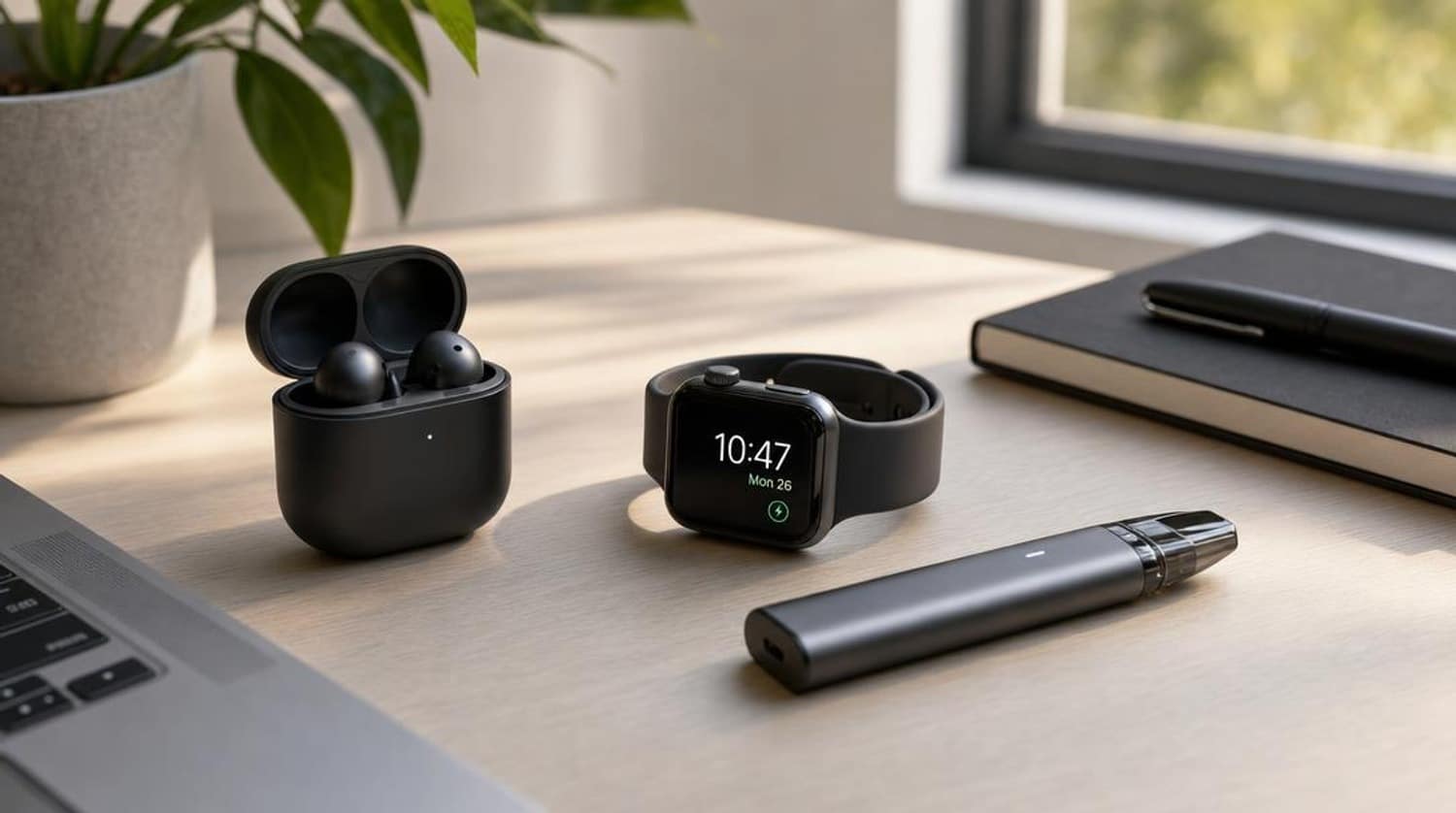
How Everyday Objects Are Transforming
Accessories that accompany our daily lives have never stopped reinventing themselves at the crossroads of new technologies and changing social practices. Where a watch used to be solely a time-reading instrument, today it’s a compact sensor hub capable of monitoring heart rate, receiving notifications, and guiding a workout. This gradual shift from functional to connected touches nearly every category of object: eyewear, earbuds, cameras, and even tools tied to managing personal habits.
This evolution isn’t merely a tech vanity. It responds to real social expectations: ease of use, personalization, reducing nuisances for those around us, and integration into a lifestyle where design and practicality matter as much as the object’s primary function. To better understand this momentum, it’s useful to observe a few emblematic accessory categories that have undergone deep mutations over the years.
Personal Audio, from Walkman to True Wireless Earbuds
Listening to music on the move has undergone one of the most spectacular transformations. The cassette Walkman of the 1980s ceded ground to the CD player in the 1990s, before the MP3 player radically reshaped habits at the turn of the 2000s. But it was the integration of audio into the smartphone that turned everything upside down: no need to carry a dedicated device, the music travels with the phone.
Headphones followed suit by shedding the last cable that connected them to the device. Truly wireless models, with no cords at all, now occupy a substantial share of the global audio-accessory market. Active noise cancellation, longer battery life, automatic wear-detection: each generation adds features that would have seemed futuristic barely a decade earlier. The charging case, compact and tucked into a pocket, has become its own accessory, sometimes sold in limited editions or in collaborations with fashion brands.
The Watch: From Horology to Connected Health
The wristwatch faced a deep identity crisis with the rise of the mobile phone. Why wear a device dedicated to telling time when the phone does it all day long? The answer arrived in the form of the connected watch, repositioning the object onto an entirely different terrain: health, physical activity, and connectivity.
Today, smartwatches measure blood oxygen, analyze sleep, detect cardiac anomalies, and can even trigger an emergency alert in the event of a fall. They’ve become health companions worn on the wrist, and some models receive medical-grade certification in countries where regulation allows. On the design front, traditional horology hasn’t stood on the sidelines: several historic brands now offer hybrid cases, blending classic mechanical aesthetics with connected features.
The Electronic Cigarette: A Mutation Driven by Shifting Habits
Among accessories that have undergone a notable mutation, the electronic cigarette holds a special place. The appearance of vaping on the consumer market in the 2000s fundamentally changed how some users approach nicotine consumption. The initial cylindrical device designed to mimic a cigarette quickly gave way to a variety of formats: box mods, compact and rectangular units, ultra-mini pods, and heat-not-burn devices.
The technology onboard these devices has advanced significantly. Early generations ran on simple coils and batteries with limited performance. Today’s models incorporate electronic chips capable of auto-adjusting power according to the coil used, display screens, and multiple safety protections against overheating or over-discharge. Some devices even allow fine-tuning of the heating curve.
The chemical and sensory aspects of the experience have also evolved considerably through the pairing of e-liquids with vaporization devices. E-liquids, available in a wide range of flavors and nicotine strengths, let users tailor the experience to their preferences. Formulations have become more precise: propylene glycol and vegetable glycerin ratios are clearly indicated, flavorings face stricter regulatory oversight in Europe, and there are ranges designed for low-resistance devices as well as for gentler vaporization.
In terms of design, the evolution is striking as well. Manufacturers use high-quality materials, refined finishes, and formats that blend discreetly into daily life. The electronic cigarette is no longer a bulky tool reserved for seasoned users: it’s now accessible to a broad audience, with beginner-friendly interfaces and rechargeable systems designed to cut down on waste.
Objects That Reflect Social Shifts
Beyond technology, these accessory transformations also tell a story about social evolution and collective expectations. Miniaturization supports an urban, mobile lifestyle. Attention to materials and environmental footprint signals a growing sensitivity to ecological concerns. And customization—whether it’s a pod color, a swappable watch band, or an e-liquid flavor—reflects a desire for individuality that spans all categories of consumer goods.
Manufacturers have embraced this dimension by building ecosystems of accessories around their flagship products. A connected watch comes with dozens of bands. A vaping device is paired with a range of coils and pods. A pair of headphones can be customized through a dedicated app. The object alone is no longer enough: the entire user experience is planned and designed.
In Summary
The evolution of everyday accessories follows a common logic: each category gradually integrates technological advances to offer more features, comfort, and customization. From wireless earbuds to smartwatches, and even electronic cigarettes, these objects have gone through rapid cycles of innovation that have profoundly changed how they are used.
This movement isn’t fixed. Flexible-display technologies, rapid-charge batteries, bio-based materials, and embedded artificial intelligence will continue shaping the next generation of accessories. For consumers, this translates into broader choices, products better suited to their habits, and an ever smoother integration of these objects into daily life.
For brands and retailers, the challenge is to stay attuned to real usage rather than merely chasing technical performance. An accessory, no matter how sophisticated, only earns a place in people’s lives if it meets a concrete need and fits naturally into their daily rituals.