
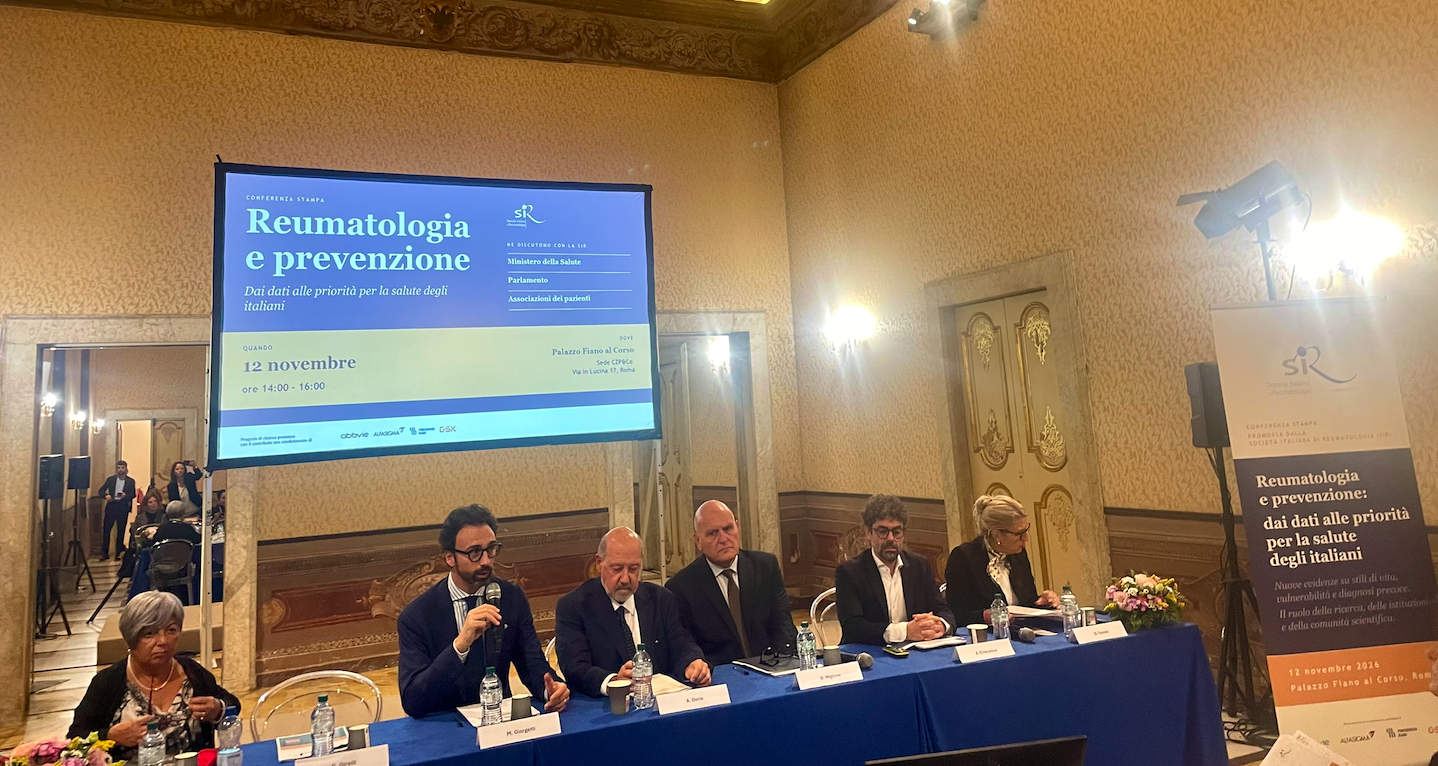
More than two years of waiting to give a name to the disease, while nearly one in two Italians chooses to live with pain without asking for help. This is the portrait captured by the survey “Health, Lifestyles and Rheumatologic Vulnerability of Italians. From the Patient Experience to Prevention Opportunities,” promoted by the Italian Society of Rheumatology – SIR, and carried out by Excellera Intelligence on 2,138 patients and 2,008 adults aged 18 to 74. The data were presented in recent days in Rome during a press conference attended by institutions, clinicians and patient associations.
A finding that weighs even more in light of the clinical advances of the last twenty-five years. As opened by the SIR president Andrea Doria, the turn of the new millennium marked a real watershed for rheumatology: from the arrival of the first biologic drug for rheumatoid arthritis to today, a toolkit that counts more than 20 biologic medicines, as many biosimilars, and 6 targeted synthetic drugs. A revolution that has radically improved prognosis, but whose actual capacity to alter the natural history of the disease and prevent irreversible damage is measured entirely by the timeliness of intervention and early diagnosis.
Underestimated diseases despite “alarm bells”
The survey highlights how rheumatologic diseases continue to be strongly underestimated by the general population: only 29% of Italians feel informed, 89% believe they mainly affect the elderly, while 58% treat them as a normal consequence of aging. Real-world data, however, tell a very different story: the average age at diagnosis is 43.5 years, and as many as 37% of patients receive the diagnosis before age 40.
“Rheumatic diseases often affect young people, right in the prime of working and family life, and they have a heavy impact on quality of life and on the sustainability of the National Health Service,” said Andrea Doria, president of the Italian Society of Rheumatology. “With this survey we aimed to compare patients’ experiences with the habits and knowledge of Italians: understanding how people lived before falling ill, how long they took to reach a diagnosis and how much the population knows about these diseases helps us identify where and how to intervene.”
Although almost the entire population (95%) reported musculoskeletal disturbances in the last six months, 52% ignored them and did not seek help. Only 23% took the initial symptoms seriously; however, more than one in three consulted four or more professionals, more than 54% received at least one misdiagnosis, and 31% took more than three years to obtain a diagnosis.
As Doria emphasized, this perceptual delay is reflected dramatically in the care pathway: from first symptoms to diagnosis, the average is 27.5 months (with more than a year wasted before accessing a specialist). The price paid by patients is high: 69% experience limitations in daily activities and 64% report negative consequences at work, with 17% having to stop working altogether.
The four vulnerability profiles among Italians
“When comparing the patients’ habits in the 2–3 years prior to the disorders with those of today’s Italians, three differences emerge,” explained Aldo Cristadoro, CEO of Excellera Intelligence — “Patients smoke more than the general population (68% vs. 40%), undergo fewer preventive checkups (37% vs. 49%), and, especially those with inflammatory arthritis, place more frequent and intense stress on their joints (61% vs. 41%). There are no notable differences for weight, alcohol and physical activity, while stress is more common (74% vs. 61%).”
The survey’s data enabled two indices to be developed: the Health Index (which measures the health of Italians) and the Self-care Index (how people take care of themselves). Crossing the two indices allowed mapping the population into four distinct clusters:
- Healthy attentive (31%): young, educated individuals with no financial difficulties who follow healthy lifestyle habits.
- Healthy inattentive (23%): people in good health who neglect preventive checkups and tend to ignore symptoms.
- Fragile attentive (20%): predominantly women over 55 who maintain steady engagement with medical checkups.
- Fragile inattentive (26%): a critical cluster largely composed of women between 35 and 54 (the so-called squeeze generation), facing financial hardship and higher rheumatologic vulnerability.
Prevention first, early recognition, better support
As highlighted by the SIR president, addressing this emergency requires a paradigm shift based on three levels of prevention:
- Primary prevention: acting on modifiable risk factors identified by the survey, such as smoking (which promotes protein citrullination and autoimmune response), stress, and mechanical overload of joints and entheses (a key factor in the development of psoriatic arthritis from psoriasis), with targeted attention to patients’ relatives (familiarity ranges from 18% to 25%).
- Secondary prevention (early diagnosis): reducing diagnostic delay through greater public information, targeted training of General Practitioners (the initial point of contact but often perceived as not decisive) and rapid access pathways to specialists.
- Tertiary prevention: limit complications, protect work capacity and preserve patients’ quality of life.
Innovation, artificial intelligence and local networks
To curb the impact of these conditions and shorten waiting lists, the scientific community, institutions and patient associations—highlighted in speeches by Giovanni Migliore, director of Communications at the Ministry of Health, Antonella Celano and Silvia Tonolo, respectively presidents of APMAAR and ANMAR—are turning to organizational models based on multidisciplinary collaboration and stronger hospital-to-territory connections.
A strategic contribution also comes from digital innovation and artificial intelligence: the use of advanced conversational tools (such as the VITA Project piloted by the Ministry for Vaccinations with results beyond expectations) demonstrates how it is possible to accompany citizens around the clock with certified information, addressing everyday questions and improving public health awareness.
Abbonati a Karla Miller