
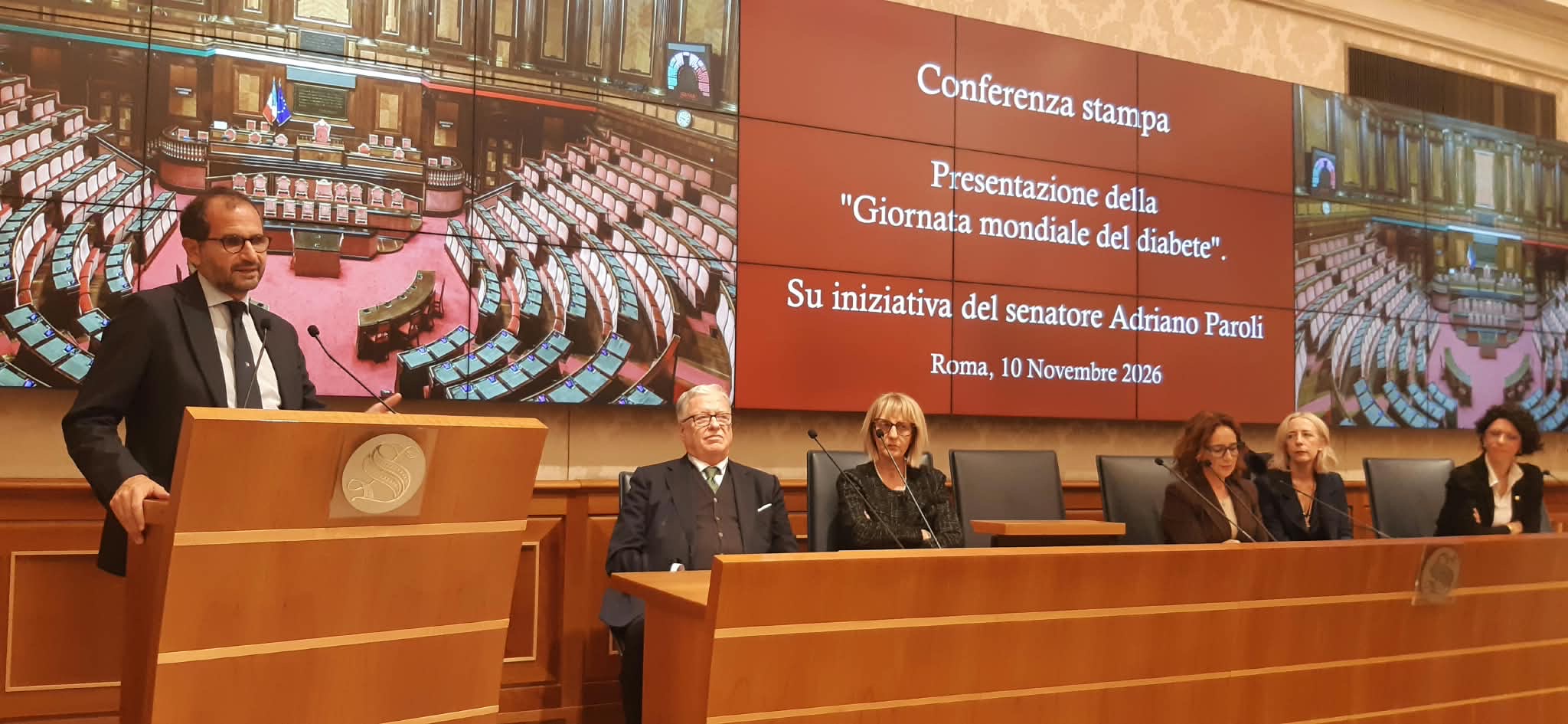
Early management of chronic conditions and the timely interception of risk factors are not merely sustainability objectives for the National Health Service; they constitute the true clinical differentiator for intervening in the natural history of metabolic diseases. This was the central point that emerged from the discussion promoted by Senator Adriano Paroli at the Sala Caduti di Nassirya on November 11, in anticipation of World Diabetes Day on the 14th, under the auspices of FAND, FeSDI, and ADI. It was a chance to benchmark the country’s epidemiological data: with about 4 million citizens diagnosed, there remains an estimated “hidden” population of more than one million people who live with diabetes without realizing it.
Beyond Glycemia: The Clinical Profile of the “Care for Life” Screening
At the heart of the scientific session was the analysis of the results from the FAND campaign “Care for Life” (winner of a Boehringer Ingelheim grant). As explained by the Federation’s National Councilor Alessandra Parisi, the study chose to move beyond a purely diabetes-centric view to adopt a targeted approach to the integrated assessment of cardio-renal-metabolic risk.
Through a validated pathway that combined the FINDRISC predictive questionnaire (for estimating the 10-year risk of developing type 2 diabetes), a point-in-time blood glucose test, and the measurement of laboratory and clinical parameters (lipid profile, blood pressure, and albuminuria), the screening engaged 512 participants in the community. The data yield striking implications for everyday clinical practice: 30.5% of the cohort carried a moderate-to-high risk of developing diabetes, 48.5% were overweight or obese, 64.5% had elevated or borderline blood pressure, and 49.4% showed dyslipidemia with elevated triglycerides.
For clinicians, possessing these predictive indices means the ability to intervene in the pre-disease phase, setting up lifestyle modification strategies before irreparable organ damage takes hold.
Clinical Perspective: Moving Beyond “Silos” Toward a Holistic View
Expanding the focus from isolated hyperglycemia to the intricate network of complications is now an imperative for the medical community. As emphasized by Salvatore De Cosmo, president of AMD, about 90% of diabetic patients have a high or very high cardiovascular risk. In alignment with the guidelines of the European Safe Hearts Plan, modern clinical management requires a rigorous risk stratification approach.
Nevertheless, translating evidence into actual patient care requires dismantling traditional organizational barriers. De Cosmo underscored the urgency of overcoming the so-called “silos” of specialty care: it is not clinically sustainable for a patient to fragment their journey into multiple separate referrals to access a diabetologist, a dietitian, or a nephrologist. Territorial integration and the development of Community Health Centers must converge toward a model of comprehensive, person-centered care.
Policy and Prevention: From Legislative Milestones to Territorial Investment
On the institutional front, Senator Stefania Craxi reminded us that the diabetes challenge raises profound questions for public institutions, noting that health is not merely a line item in the budget but the cornerstone of social well-being. Italy reaffirmed its leadership role thanks to regulatory measures such as Law 130 of 2023, which made the country the first in the world to introduce pediatric screening for type 1 diabetes and celiac disease, and the historic Law 115 of 1987, which shields patients from any form of discrimination.
A vision shared by Undersecretary of Health Marcello Gemmato, who reiterated that prevention is the governing axis of government policy, supported by a funding package of €500 million and structural measures such as the obesity law (a leading trigger for type 2 diabetes). In addition to embracing new technologies, Gemmato highlighted the importance of bringing pharmacological management closer to the chronic patient through the territorialization of treatments (such as the transfer of DPP-4 inhibitors and SGLT2 inhibitors into community-based distribution), a move that optimizes therapeutic adherence, reduces hospitalizations, and supports the overall sustainability of the health system.
Subscribe to Integrated Medicine