
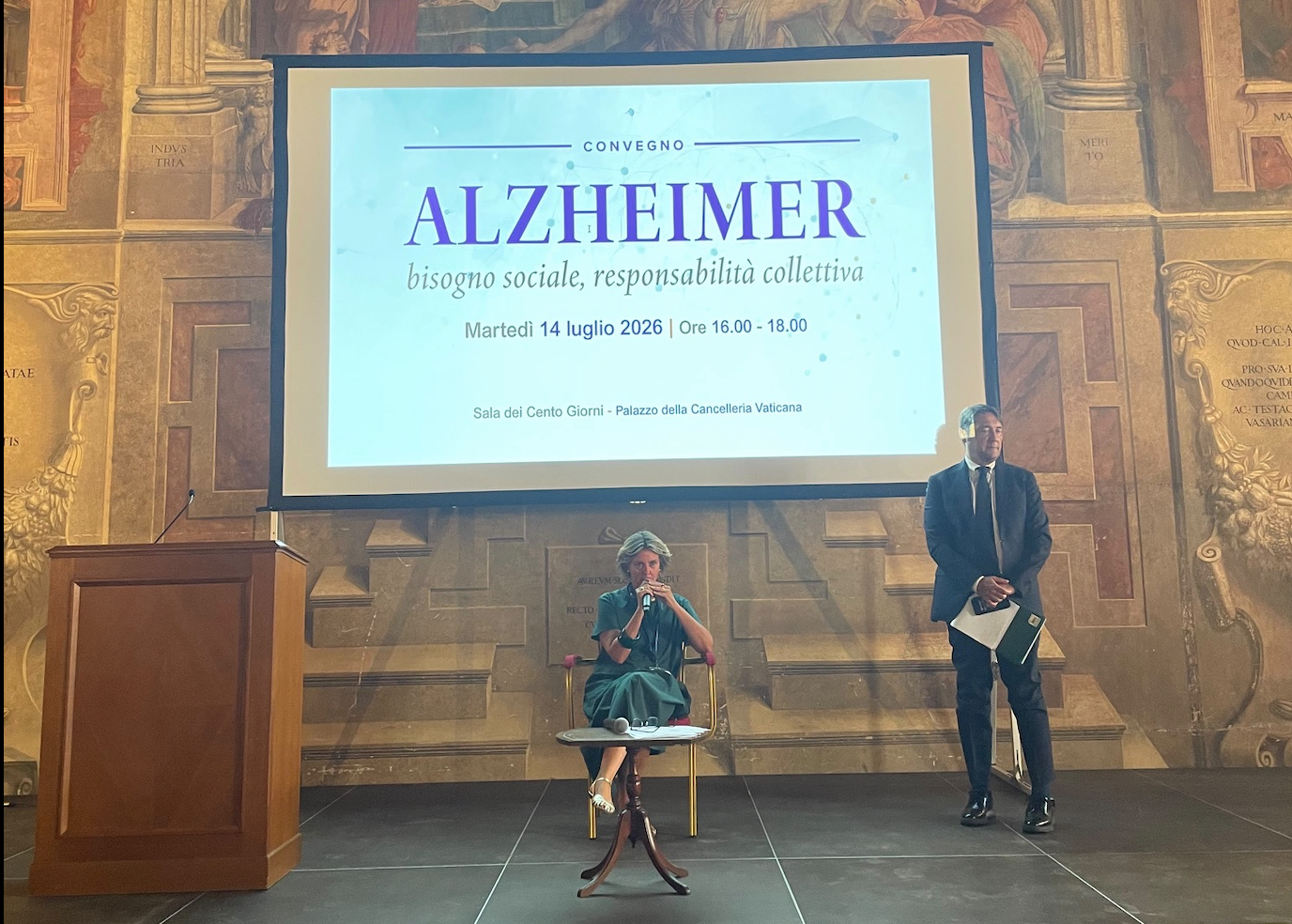
Alzheimer’s disease can no longer be regarded merely as a complex neurological challenge. It is, in effect, a social emergency, a matter of human dignity and equity that directly confronts the collective conscience. This was the strong message that emerged in Rome on July 14 at the event “Alzheimer: social need, collective responsibility,” held at the Vatican Prefecture Palace with the presence of the Parliamentary Intergroup for Neurosciences and Alzheimer’s, as well as institutions, scientific societies, and patient associations who shared moving stories of a daily life made difficult.
In Italy, the numbers describe a true national priority: more than 600,000 people live with the disease, with over 3 million family members and caregivers engaged daily in a substantial caregiving burden. A reality likely to widen as the population ages.
A scientific turning point between hope and barriers to access
The scientific community today faces an epochal paradigm shift: the arrival of anti-beta-amyloid therapies, capable of directly influencing the biological course of the disease in its early stages. Yet the debate is heated, particularly after the recent decision by the Scientific and Economic Commission of AIFA on the non-reimbursability of these treatments by the National Health Service.
«The new anti-beta-amyloid therapies represent a new frontier of hope for people with Alzheimer’s and their families. The ongoing discussion cannot ignore those patients who can truly benefit from them, through clinically measurable outcomes» stressed Mario Zappia, president of the Italian Society of Neurology (SIN).
The “tight window” of diagnosis and the role of biomarkers
If pharmacological innovation opens new paths toward increasingly personalized treatments, as also recalled by the president of AIFA, Robert Nisticò, real clinical effectiveness cannot overlook timely diagnosis. Today, however, there are strong delays: more than 80% of patients do not receive biomarker-based tests, and the average waiting times for a specialist evaluation exceed five months.
«The timing of diagnosis and treatment presents a narrow window to optimize the balance between benefits and costs. For this reason it is essential to guarantee early access to biological diagnosis and, when indicated, to therapies» recalled Marco Bozzali, president of the Italian Society for Neurology of Dementias (SINDEM).
To achieve this, an organizational evolution on the territory appears crucial. As highlighted by Pasquale Palumbo, president of the Society of Hospital Sciences of Neurology (SNO), it is necessary to «strengthen the capacity of the health system with forward-looking planning, investing in skills, infrastructure and integration with primary care».
The person at the center: the ethical and social appeal
The event calls for not isolating families, often left to cope alone with a devastating emotional and economic burden. A principle of proximity that echoes the words from the months prior by Pope Leo XIV, who argued that health must be a right guaranteed to all, starting with the most vulnerable.
«Alzheimer’s is a challenge that concerns not only medicine, but also the way society takes care of its most vulnerable people. It probes the deepest meaning of care, understood not only as treatment, but also as closeness, responsibility, and a choice of civility» stressed Monsignor Marcelo Sánchez Sorondo, Emeritus Chancellor of the Pontifical Academy of Sciences.
On the same wavelength, patient associations are calling loudly for territorial equity and uniform protections.
«Families embrace the Pope’s words, “No one should be left alone, care is a sign of hope and proximity,” to demand the long-awaited access to innovation, early and timely diagnosis, and appropriate care for all stages of the disease, without geographic or economic disparities» emphasized Patrizia Spadin, president of the Italian Alzheimer’s Association (AIMA).
The necessary political responses
The path charted for the near future requires concrete, structural political choices.
«The increase in longevity is a major achievement but brings with it an increasingly urgent challenge. Alzheimer’s and dementias are set to grow substantially in the coming decades. Behind numbers that could more than double by 2050 are people and families who face every day a complex and highly disabling disease. This is why it is essential to invest today in prevention, early diagnosis, access to therapies, and support for caregivers, building a care network capable of meeting the needs of an aging population», underscored Senator Beatrice Lorenzin, co-chair of the Parliamentary Intergroup for Neuroscience and Alzheimer’s.
The Honorable Annarita Patriarca, co-chair of the Intergroup, concluded by reaffirming the need to «turn this awareness into concrete choices, starting with strengthening the National Plan for Dementias and stabilizing the Alzheimer’s Fund, so that patients and families can rely on reliable resources». Only through structural integration between healthcare, territorial social services, and active support for caregivers can we guarantee a dignified, equitable, and truly integrated care ecosystem.
Abbonati a Karla Miller