
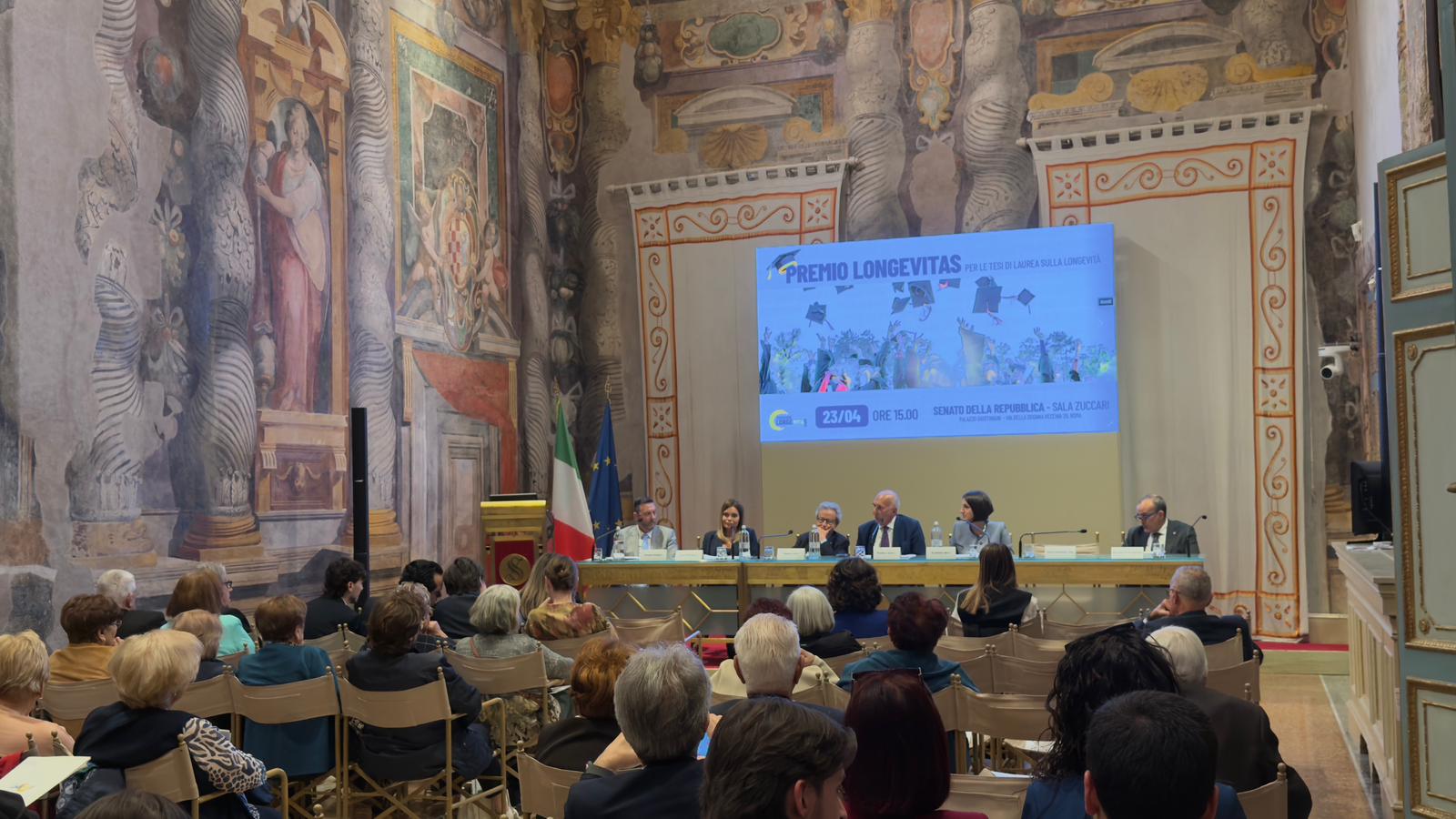
Longevity, as a health, social and economic challenge, occupied the center stage of today’s scientific and institutional debate. In Rome, at the initiative of Senator Guido Liris, in the Zuccari Hall of Palazzo Giustiniani, the ceremony awarding the second edition of the Longevitas Prize took place—a initiative promoted by the Longevitas Foundation and dedicated to young graduates and current students of Italian universities engaged in active aging and quality of life topics.
The 2026 Edition
During the event, the three winners of the Longevitas 2026 Prize were announced, selected among the best theses devoted to prevention, healthcare innovation and the development of sustainable models for a society that is increasingly longeve.
The winning theses tackled topics central to a society increasingly oriented toward longevity. The subjects range from using music as a therapeutic tool to improve the well-being of patients with dementia, to developing new models for measuring frailty in the elderly population, to analyzing the well-being and inclusion of workers over 50, with particular emphasis on active aging policies.
The first prize was awarded to Cristina Vesprini, the second to Maurizio Nicolaio and the third to Matilde Maniscalco. The works stand out for their innovative approach and for their attention to quality of life, prevention and the sustainability of healthcare systems.
To the winners, the opportunity to participate in the Milan Longevity Summit, scheduled for May 20–23.
Toward an Integrated Vision of Longevity
The Prize confirms itself as a moment of dialogue between institutions, the scientific community and the academic world, with the aim of promoting an integrated view of longevity, able to combine quality of life, health and innovation. In a context marked by the lengthening of life expectancy, the need to rethink prevention and care models becomes evident, valuing the contribution of research and of the new generations.
«Longevity is today a question of quality of life built over time, which concerns everyone at the intergenerational level – says Andrea Lenzi, President of the National Research Council. – In this regard, research is essential: it allows us to understand how the environments we live in influence our well-being, our health and our relationships. Only through a multidisciplinary approach – combining science, urban planning, medicine, sociology and culture, all themes explored by the theses presented – can we design truly livable and welcoming places, capable of supporting people throughout the lifespan».
In this scenario, the participation, as a special guest, of Laurent Simons, a young researcher with an international profile, took place. His address offered a contribution of great interest on the most advanced perspectives of scientific research, highlighting the role of the integration between physics, artificial intelligence and life sciences in the study of aging processes.
«Throughout history – according to Simons – humanity has undergone several scientific and technological revolutions. Yet none of these, however important, will have the impact that the science of aging and longevity will have. It is wonderful to see that Italy, where the human body, beauty and the celebration of life are so deeply rooted in the Italian lifestyle, has promoted a national initiative through the Longevitas Foundation, aimed at stimulating and rewarding students who dedicate themselves to extending healthy life expectancy through innovative and multidisciplinary research.
Simons’ work concentrates on the analysis of complex systems and the development of innovative models capable of interpreting the biological mechanisms of aging, with potential applications in personalized medicine and prevention. A perspective that fits within the broader landscape of longevity research and strengthens the dialogue among disciplines, one of the key elements promoted by the Longevitas Foundation.
«Longevity is not only a demographic datum, but a profound transformation that concerns the way we live, take care of ourselves and participate in society – adds Eleonora Selvi, president of the Longevitas Foundation. – Investing in prevention, in research and in the skills of the new generations means building concrete answers to this challenge. The Longevitas Prize represents an important step in this journey, because it highlights ideas and projects capable of impacting quality of life and the sustainability of health systems.»
«In a context where longevity is increasingly taking shape as a health, social and economic challenge – continues Alberto Beretta, president of the SoLongevity Foundation – initiatives like the Longevitas Prize demonstrate the crucial role of research and new generations in redefining models of health and care. In this same direction lies the Milan Longevity Summit, which represents an international benchmark for dialogue between science, institutions and innovation. The Summit is designed to integrate multidisciplinary competencies, promote a systemic view of aging and contribute to the development of concrete strategies to improve the quality and duration of life across the entire lifespan. We are pleased that the Longevitas Foundation again joins us on this journey and to contribute our expertise to the Longevitas Prize»
Abbonati a Karla Miller