
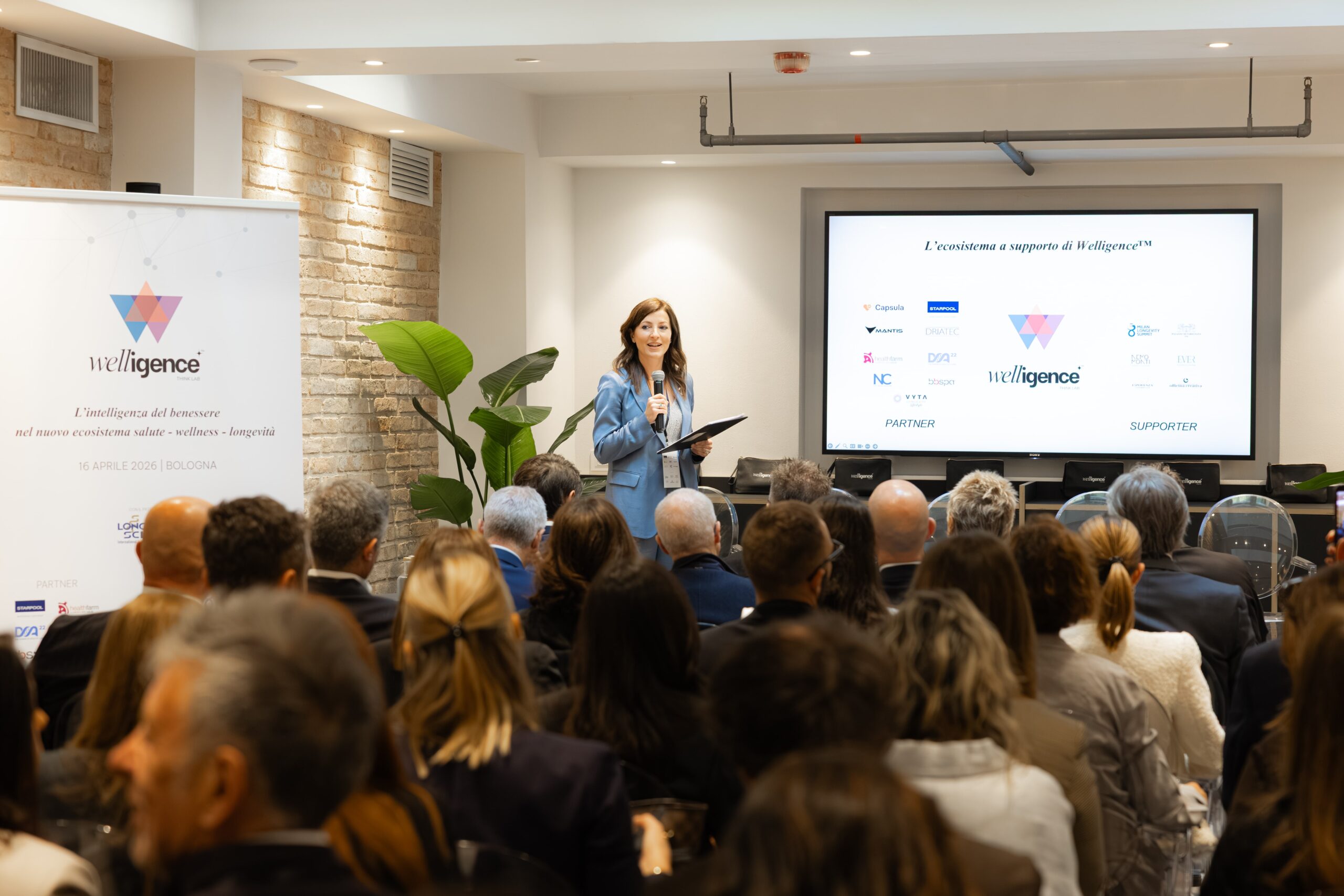
On April 16 this year, Bologna’s Portici Hotel hosted the inaugural edition of Welligence™ Think Lab. The objective was to foster dialogue between health, wellness, and longevity, interpreting them as parts of a single cultural, entrepreneurial, and relational ecosystem.
Welligence is evolving from an event into a permanent platform. The aim is to monitor the evolution of the sector and help define new communication standards based on trust, accountability, and measurability. At the heart of the Think Lab is a shared awareness: health can no longer be told only as care, wellness cannot stop at the experience, and longevity cannot remain an abstract promise. We need a more authoritative, human, and measurable language, capable of integrating trust, evidence, and accessibility.
conceived by Roberta Farinola and realized with the patronage of the Longevity Science Association, Welligence was created to answer a growing need: to build a common language across sectors that today converge on the same personal needs but have so far communicated separately.
«Welligence grows from a clear vision: health, wellness, and longevity are no longer three sectors, but a single ecosystem that requires new languages, new models, and new responsibilities. With this project we commit to a precise pledge: to help construct a cultural reference for the entire sector, guiding a change that affects not only businesses, but the way people live, understand, and choose their own well-being. Today we are creating a new culture, and we are proud of it,» Farinola declares.
Three Perspectives on the Future of Health, Wellness, and Longevity
In Bologna, three panels were presented to explore the new ecosystem.
The first, “Designing Trust: How the Language of Health Is Changing”, highlighted the shift from traditional medical communication to integrated prevention models. Among the speakers, Franco Balestrieri of ICS Maugeri emphasized the need to move beyond desire-driven marketing toward communicating necessity, integrated into organizational processes. Balestrieri also cited Law 219/2017 from the National Deontological Council FNOMCeO 2014, which expresses a fundamental concept: “the time of communication between doctor and patient constitutes time of care.” Nicola Castaldini of GVM Care&Research underscored the role of the therapeutic alliance, built on competence, listening, and continuity, supported by monitoring and telemonitoring. Castaldini also reminded everyone how essential the physician’s phase of “empathetic listening” is to truly engage with the person in front of them—the patient. Francesco Annunziata of Health Farm outlined the evolutionary model of the “health gym,” integrating prevention, experience, and multidisciplinary collaboration.
The second panel, “From Lifespan to Healthspan”, demonstrated how longevity is moving from vision to concrete practice. Among the voices, Lucia Magnani of Long Life Formula reiterated the need for measurable clinico-scientific models. Hannes Ilmer of Villa Eden presented a highly personalized and relational approach. Luigi Caterino of Longevity Suite made longevity a city service that is accessible. Daniela Nuti Ignatuk of DNA22 highlighted the importance of individual pathways based on data and continuous adaptation. Umberto Carraro of Vyta Longevity emphasized the role of medical leadership and systemic integration.
The third panel, “Wellness: The New Intelligence of Places and Territories”, explored the evolution of wellness through a territorial and strategic lens. Mirella Prandelli of Lefay Resort & Spa presented wellness as a brand philosophy integrated with the local territory. Alberto Arrighi of QC Spa of Wonders discussed transforming the spa into a social and experiential space. Ambra Lee Agnoletti of Minor Hotels highlighted wellness as a global driver of hospitality. Antonio Ducceschi of GB Thermae Hotels stressed the scientific framing of thermalism’s evolution. Jennifer Theiss of Palazzo di Varignana brought the themes of measurability and standardized protocols into wellness.
The First Welligence Manifesto
At the close of the event, the First Welligence Manifesto was unveiled—an ongoing space for analysis dedicated to the evolution of languages, models, and perceptions across the three realms, anchored on five pillars:
- We are witnessing a paradigm shift, not a trend. Health, wellness, and longevity are not merely converging: they are redefining together what it means to be well. It’s no longer a sector issue but a systemic one.
- Well-being doesn’t happen by itself. It happens within designed systems. Places, relationships, languages, protocols—everything that builds experience—contributes to building well-being. Those working in these areas don’t just offer solutions; they build contexts.
- We are a field in formation, not yet a fully formed system. Practices exist; models exist. Shared languages and a common framework are still missing. Naming and structuring this field is part of the work.
- Well-being is shifting from response to project. No longer only reacting to illness or discomfort, but actively creating conditions. Not as episodic consumption, but as a continuous, individual and collective practice.
- The real question isn’t how long we live. It’s how we want to live. Science and sensitivity, technology and humanity, individual and community, short-term and long-term: balancing these tensions is the cultural mission of anyone operating in this ecosystem.
Subscribe to Integrated Medicine