
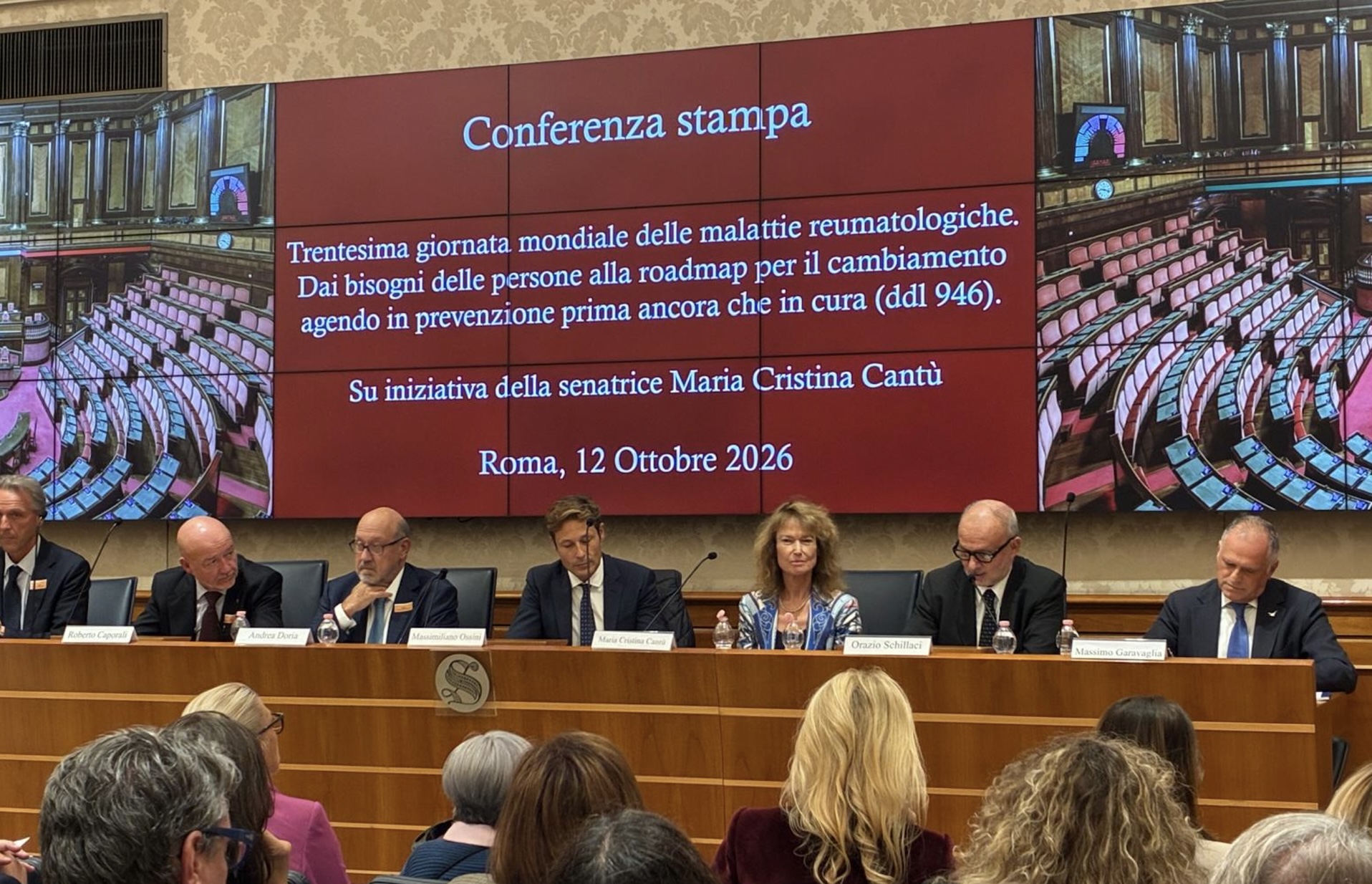
The collective imagination still too often confines rheumatologic diseases to the realm of old age or reduces them to mere painful manifestations of the musculoskeletal system. The reality unveiled by the presentation of the first Italian Rheumatology White Paper, held in the Nassiriya Fallen Hall of the Senate at the initiative of Senator Maria Cristina Cantù on October 12, during the 30th World Day of Rheumatic Diseases, paints a much more serious picture.
In Italy, more than 10 million citizens live with a rheumatic disease, and for about 734,000 of them the condition takes on the contours of severe disability.
The Profile of Rheumatologic Diseases
These conditions comprise a complex constellation of more than 200 diseases that spare neither childhood nor adolescence, nor the young adult population, instead striking with particular intensity during the peak years of work life and reproductive years.
The data speak clearly: 68% of patients who qualify for exemptions from costs due to chronic disabling rheumatic diseases are women, and in more than half of cases they fall in the 45–65 age bracket. This translates into an extremely significant economic and social impact on the entire national system. Looking at just three widespread conditions—rheumatoid arthritis, psoriatic arthritis, and ankylosing spondylitis—it is estimated that more than 23 million workdays are lost each year, with total direct and indirect costs exceeding €4 billion.
The Therapeutic Revolution, the Two Clinical Dimensions, and the Challenge of Early Diagnosis
In light of such substantial figures, the last two decades have witnessed a true turning point from both scientific and clinical standpoints. As Andrea Doria, president of the Italian Society of Rheumatology, emphasized, today medicine has at its disposal biologic drugs, targeted molecules, biosimilars, and screening biomarkers that enable precise risk stratification even before clinical symptoms appear.
The fundamental objective of the field has evolved: it is no longer only about easing pain or managing symptoms, but about preventing structural and organ damage, guiding the patient toward disease remission.
To achieve this milestone, intervention must occur within the so-called “window of opportunity,” that is, in the very early stages of disease onset.
Doria recalled that rheumatology management must operate on two distinct yet tightly interconnected levels: on one hand territorial rheumatology, charged with the framing and management of widespread musculoskeletal problems, and on the other hand university-hospital rheumatology, a crucial hub for care of rare, complex, and systemic diseases affecting vital organs. Unfortunately, the ability to deliver a timely response on both fronts is currently hindered by substantial organizational bottlenecks. Consider that in several regions, wait times for a first rheumatology consultation exceed six months, and about 23% of territorial ambulatory rheumatologists are not authorized to directly prescribe biologic medicines, obliging patients to endure exhausting pilgrimages to authorized facilities.
Among other critical issues raised, the associations front, Antonella Celano of APMARR and Silvia Tonolo of ANMAR, have drawn particular attention to the transition from pediatric to adult care, which would benefit from structured pathways to prevent information loss and poor adherence among patients.
The SIR’s Five Demands and the Scope of Bill No. 946
To overcome these obstacles and shape an integrated and proactive health system, the SIR has tied its proposals to the institutional track of Bill No. 946, promoted by Senator Cantù. The aim is to transform the territorial challenges into opportunities for an organic reform of the National Health Service, ensuring early diagnoses, uniform care pathways, and full recognition of the discipline within health policy and academia.
To that end, the White Paper condenses its operational proposal into five strategic actions aimed directly at policymakers:
1. Territorial needs planning: align the supply by establishing a benchmark of 30 hours per week of territorial rheumatology specialty care for every 100,000 inhabitants.
2. Dedicated hospital beds in reference centers: reorganize Complex Operational Units (currently only 42 across Italy, less than one per million inhabitants) to ensure beds reserved for the management of the most complex and rare patients according to the actual regional catchment.
3. Regional networks and homogeneous PDTA (Diagnostic-Therapeutic Pathways): establish nationally shared diagnostic-therapeutic pathways to eliminate current geographic disparities and guarantee fair, timely access to innovative therapies and biosimilars.
4. Strengthening university training: standardize rheumatology education in medical school curricula (where continuing education credits currently range erratically from 1 to 4) and ensure the presence of at least one full professor of the discipline at every medical school campus.
5. Translational research and digital health: continue investing in scientific research and in identifying new biomarkers, a field where Italian rheumatology ranks among the world’s leaders with more than 17,000 PubMed publications in a decade, while promoting telemedicine, disease registries, artificial intelligence, and interoperable electronic health records.
Primary Prevention, Lifestyles, and Integrated Patient Protection
The entire White Paper roadmap harmonizes with the imperative to couple the most advanced frontiers of precision medicine with a culture of primary prevention and healthy living. In a demographic context marked by population aging and low birth rates, sustaining the welfare system cannot be separated from a holistic, person-centered approach to care. Physical activity, adapted sports, and what is termed nutritional medicine constitute valuable non-pharmacologic tools to prevent functional decline, preserve muscle mass, and reduce systemic inflammatory load.
From this perspective, the synergy between rheumatology specialists, primary care, and regional networks represents the foundational pillar for early disease interception, safeguarding the right to work and social integration for citizens, and turning rheumatology into a true investment in healthy longevity for the entire country.
Subscribe to Integrated Medicine