
Dementia represents one of the world’s most significant health and social challenges, with tens of millions of cases worldwide expected to double in the coming decades due to population aging. In Italy, data presented by the Istituto Superiore di Sanità outline a genuine social and economic emergency:
- Over 1.2 million people over 65 live with some form of dementia;
- Between 550,000 and 600,000 are patients with Alzheimer’s disease;
- Approximately 950,000 people have a mild neurocognitive disorder (MCI);
- 24,000 are early-onset cases (between 35 and 64 years).
The overall economic impact approaches €23 billion per year. The most critical aspect concerns the distribution of costs: 63% falls directly on families, underscoring how caregivers remain the essential, yet often invisible, backbone of the entire welfare system.
The Event at the Ministry and the Opening by Minister Schillaci
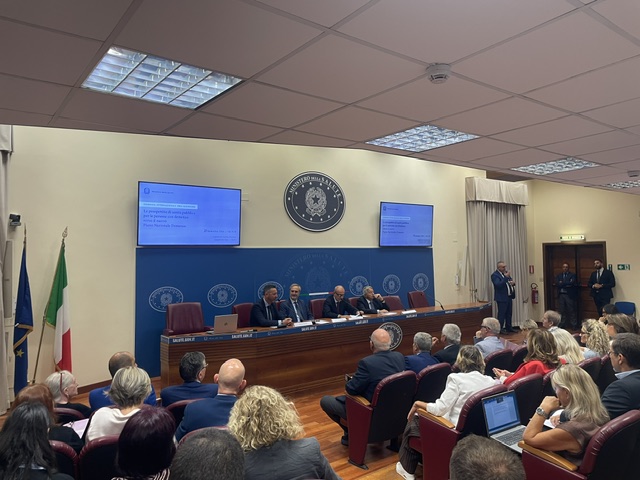
On September 21, World Alzheimer’s Day, the Ministry of Health hosted at the Cosimo Piccinno Auditorium the event “Public health Perspectives for People with Dementia”.
The event was opened by Minister Orazio Schillaci, who announced the government’s intention to include dedicated funding in the upcoming budget bill to support the implementation of the new National Dementia Plan (PND 2027-2031), a document that will be transmitted by the end of October to the Unified Conference.
«We are working on a funding proposal for the next Budget Law to support the implementation of the Plan and to strengthen the public health responses for prevention, diagnosis, treatment, and support for people with dementia and their families », said Schillaci, highlighting that the goal is – to ensure continuity, reduce territorial disparities and allow local areas to adjust offerings to actual demand, without leaving families on their own».
Health authorities reminded that the phenomenon affects roughly 10% of the Italian population when considering the entire network of patients and their families.
The Seven Pillars of the PND 2027-2031: From Prevention to Research
Twelve years after the first plan in 2014, the draft of the new Plan (approved at the September 8, 2026 meeting) fully embraces the directives of the World Health Organization, outlining seven strategic pillars designed to accompany the patient and family throughout the entire course of the disease:
1. Prevention and modifiable risk factors: reducing the impact of 14 risk factors across the life span (hypertension, sedentary lifestyle, smoking, social isolation, hearing loss, etc.). The ISS estimates that addressing these aspects could prevent almost 40% of cases.
2. Awareness and stigma reduction: fostering a culture of inclusion to promote dementia-friendly communities.
3. Early diagnosis and care continuity: strengthening the network of 587 Centers for Cognitive Disorders and Dementias (CDCD) and expanding telemedicine and tele-rehabilitation.
4. Support for caregivers and social inclusion: pathways of guidance and psycho-educational support for families, with attention to vulnerable groups (including the IMMIDEM project for migrant populations).
5. Early-onset forms and rare diseases: developing dedicated clinical-care pathways for early diagnoses and complex conditions such as frontotemporal dementia.
6. Information systems and monitoring: uniform mapping of services across the territory and the definition of national indicators to overcome regional disparities.
7. Scientific research and innovation: promoting clinical and organizational research and combined treatments (pharmacological and non-pharmacological).
The Voice of Associations: “The Plan Must Not Remain a Paper Document”
It was the cry of alarm from patient groups that sparked the day’s most profound debate. The longstanding associations, including the Alzheimer’s Federation Italy, AIMA, Alzheimer Uniti, the National Association for Dementia Impact, and the Frontotemporal Association, brought to the floor the daily challenges faced by those living with the disease in solitude.
In particular, the Alzheimer Federation Italy issued a clear warning to authorities: the new National Plan cannot and must not remain a mere programmatic document resting on ministerial desks.
After years of fragmented initiatives and time-limited funding, families need to see guiding principles translated into concrete services on the ground. The collective request is to ensure structural and ongoing resources (at least €500 million for the next three years) so that diagnostic innovations are matched by a real network of home care, day centers, and dedicated hospital beds.
Associations also emphasized early-onset and less common forms, such as frontotemporal dementia, where the lack of facilities and specialized pathways is even more dramatic and uneven across regions.
Innovative Therapies. The AIFA Position, Between Hope and Caution
A crucial part of the conference focused on the prospect of new disease-modifying drugs (the so-called disease-modifying therapies directed at amyloid for early MCI or mild dementia). The director-general of AIFA, Pierluigi Russo, offered a precise and balanced analysis of the regulatory and organizational challenges facing the country.
Russo noted that the advent of these therapies marks a paradigm shift in science, but also calls for extreme caution in assessing the benefit-risk ratio based on evidence from clinical trials. The primary objective of the Italian Medicines Agency is twofold: to avoid creating false expectations in patients with advanced stages for whom the drug would not be indicated; and to ensure that no inequities in access to care are produced.
To achieve this, the health system must prepare to select eligible candidates through accurate biological diagnosis (biomarkers and specialist imaging), building clear pathways so that approved and reimbursed treatments are delivered promptly and consistently across the country.
The National Campaign: Giving Voice to Patients and Caregivers
The event also served as the platform to present the new National Dementia Communication Campaign, promoted by the Ministry of Health, ISS, and AIFA in close synergy with patient associations, which will be launched in 2027. A project designed to break the social stigma that still surrounds cognitive decline and to counter misinformation that confuses families.
The campaign aims to place the voices and faces of those living with the disease at the center, from patients to their families. Through a broad, dual-channel approach—across social media and targeted informational tools, including practical handbooks on diagnosis, rights, daily management, and adapting home environments—the initiative seeks to guide citizens through the milestones of the disease, promote prevention of risk factors, and highlight contact points and support resources (such as the CDCDs and useful helplines) available nationwide.

Abbonati a Karla Miller