
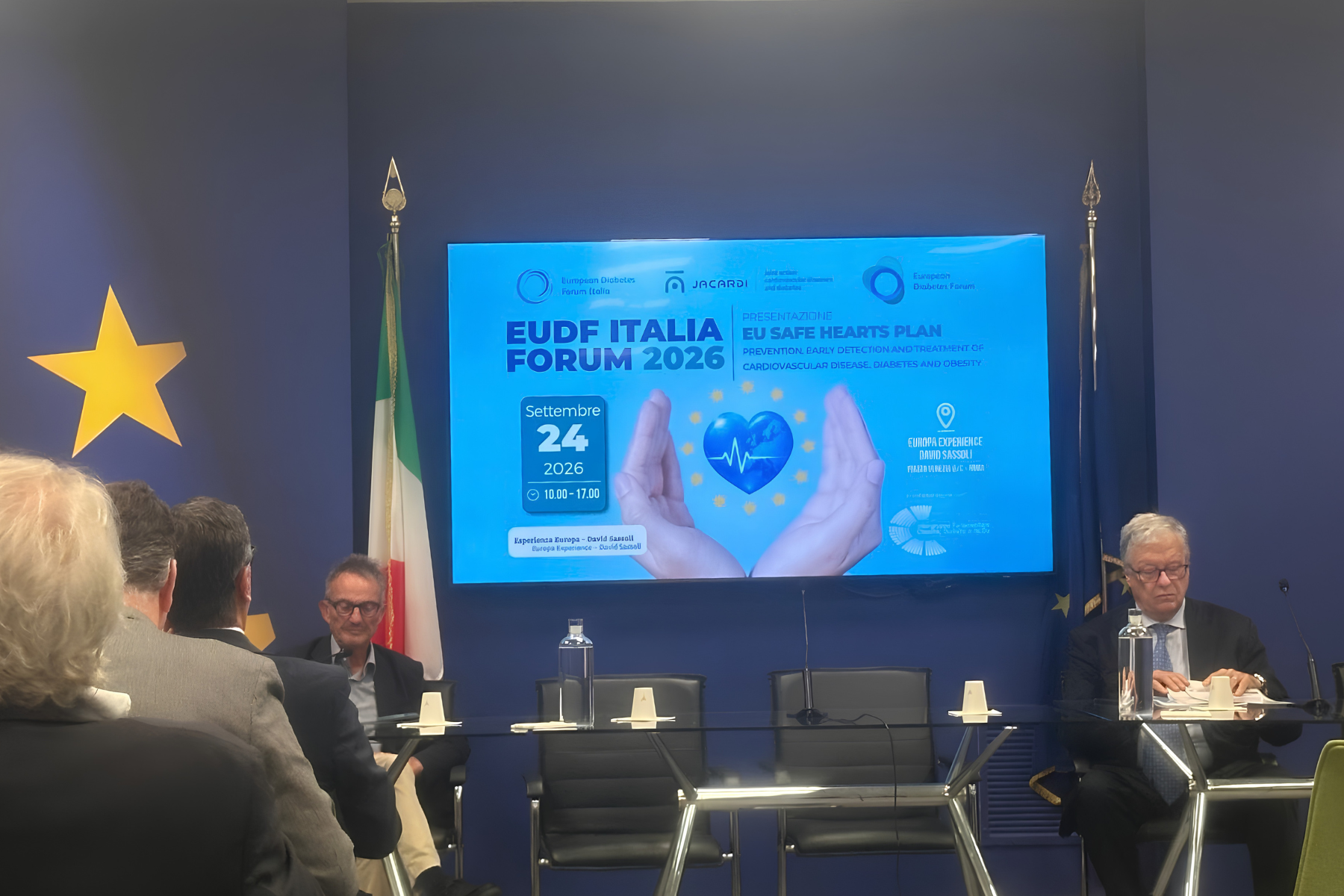
On September 24, in Rome, at Europe Experience – Davide Sassoli, promoted by EUDF Italia and EUDF – European Diabetes Forum, an encounter took place among institutions, scientific societies, and health system stakeholders with the aim of developing operational proposals, shared and aimed at identifying the strategic priorities for the future of cardiometabolic health in Europe. An open exchange designed to foster greater coordination among all interested stakeholders.
Towards an Integrated Approach to Cardiometabolic Health
Coordination among policymakers, the scientific community, and civil society represents a crucial hinge for addressing in a holistic manner the growing complexity of chronic diseases. Through the contribution of the eight Working Tables of EUDF Italia and ongoing dialogue with the main players in the health sector, the initiative sought to structure a path aimed at producing analyses, evidence, and usable solutions at the programming and institutional levels.
At the heart of the discussion was the drafting of the official document “EUDF Italia Position Paper 2026,” which distills the recommendations and directions that emerged from the work. A primary focus concerns defining operational action lines to support the EU Safe Hearts Plan, oriented toward fostering a strong synergy between European and national strategies dedicated to the prevention and integrated management of cardiovascular diseases, diabetes, and obesity.
In this light, the event served as a key coordination moment to strengthen alignment with the European project JACARDI (Joint Action on Cardiovascular Diseases and Diabetes), promoting coordinated and structured action across ongoing national and European initiatives. In this sense, EUDF President Chantal Mathieu underlined that while it is important to structure projects at the European level, they must then be effectively implemented in individual countries to translate into operational strategies and tangible patient benefits.
The Epidemiological Impact: Cardiovascular Diseases and the Crucial Role of Diabetes
Cardiovascular diseases continue to be the leading cause of mortality both at European and national levels, markedly impacting the sustainability of health systems. In Europe, 1.6 million deaths occur each year due to cardiovascular diseases (about 32% of total mortality), with roughly 66 million people living with these conditions (1 in 7 people). The global economic impact is estimated at €282 billion annually (about 2% of the European GDP), of which €27.6 billion relate to disability.
In Italy the picture is particularly severe: more than 9 million people live with cardiovascular diseases, with 206,000 deaths per year and total costs (direct and indirect) amounting to €42 billion annually (about 2.1% of national GDP).
Within this scenario, diabetes plays a decisive role as both a risk factor and an accelerator of cardiovascular damage. Data from the Italian Barometer Diabetes Report 2025 show that in Italy about 3.7 million people live with diabetes (6.3% of the total population and 7.7% of the adult population). The incidence of the condition rises sharply with age, hitting 15.5% among those aged 65–74 and more than 20% among those over 85. Complicating the picture are obesity and a sedentary lifestyle, with 12.5% of people with diabetes being sedentary, compared to 7.7% among the working population.
Strategic Turning Point: Integrated Prevention and the Key Value of the Diabetes Registry
The aging population, the amplifying effect of diabetes, and the coexistence of obesity and chronic kidney disease demand a move beyond siloed management, calling for an integrated cardio-nephro-metabolic life-course approach (life-course approach).
In this context, the entry and full operation of Diabetes Registries represent the decisive instrument and turning point: having epidemiological and clinical data that are structured, interoperable, and up-to-date on diabetes not only allows monitoring the disease’s evolution but also enables early detection of cardiovascular complications, guides primary and secondary prevention, and plans timely, personalized therapeutic interventions.
The EU Cardiovascular Health Plan – The Safe Hearts Plan fits into this trajectory by aligning national programming with the main regulatory and funding tools (National Prevention Plan, Chronic Care Plan, FSE 2.0, EHDS, PNRR, and the JACARDI project).
As highlighted by Angelo Avogaro, coordinator of EUDF Italia: «EUDF Italia proposes transforming the Safe Hearts Plan into a permanent national platform for cardio-nephro-metabolic innovation and prevention, grounded in governance shared between the State and the Regions and a multidisciplinary approach capable of overcoming the fragmentation still present in the National Health Service. The Safe Hearts Plan is not only a new European policy but a concrete opportunity to modernize the National Health Service and to strengthen prevention as a strategic investment for health, economic growth, and the sustainability of the country».
Operational Proposals of the Policy Paper
The recommendations developed by the eight Working Tables of EUDF Italia to translate the strategy into concrete interventions (which will also be presented at the EASD Congress in Milan from September 28 to October 2) include:
- National Cardio-Nephro-Metabolic Plan: definition of an integrated strategy coherent with existing planning tools.
- Screening and early diagnosis: activation of universal and interoperable programs for the assessment of cardiovascular and metabolic risk.
- National Steering Cabine: central body for coordination, monitoring, and evaluation of the impact of health policies.
- National Cardio-Nephro-Metabolic Data Hub: interoperable data infrastructure with FSE 2.0 and EHDS.
- Strengthening the territorial network: leveraging Community Hubs, the Services Pharmacy, and telemedicine.
- Equitable access to innovation: ensuring uniform availability of innovative therapies across the territory.
- Addressing inequalities: monitoring inter- and intra-regional care gaps, with a focus on vulnerable groups, inland areas, gender, and migrant populations.
- Health Promotion (Life-course approach): active involvement of schools, workplaces, and local administrations.
Implementing Diabetes Registries within the JACARDI Project
The operational focus on Diabetes Registries found ample space during the Forum, which hosted a coordination meeting between the lead representatives of the territorial pilot projects of the European Joint Action JACARDI (Joint Action on Cardiovascular Diseases and Diabetes) and national institutions.
The meeting provided a status update on the progress of the Italian pilots for implementing the Diabetes Registry (Type 1 and Type 2), ensuring full alignment with the pathway of the National Diabetes Registry Decree. The collaboration with EUDF Italia aims to consolidate a robust monitoring infrastructure capable of transforming the collection of diabetes data into a driver for prevention and the care of cardiovascular complications.
Regarding the strategic value of the Registries, Benedetta Armocida and Graziano Onder (JACARDI Coordination) stated: «The challenge is not merely having more data, but building systems that turn data into knowledge and knowledge into decisions that genuinely improve people’s health. JACARDI’s work on Diabetes Registries shows how innovation can emerge from the regions and, through dialogue among Regions, institutions, professionals, scientific societies, and patient groups, become a shared asset of the health system. Building these tools together makes them more responsive to real needs, helps reveal inequalities, and is robust enough to continuously guide planning, prevention, and care over time».
Abbonati a Karla Miller