We’ve all watched an English-language interview with Marion Cotillard and wondered, “How does she do it?” Her accent is light, musical, just French enough to be charming without ever getting in the way of understanding. Omar Sy does the same thing in the other direction when he switches from French to English on an American set: fluent, natural, with an ease that makes it seem effortless.
But it isn’t easy. What these stars show in their interviews is the result of years of work, vocal coaching, relentless practice, and above all, constant exposure to the language. And the good news is that the techniques they use aren’t reserved for celebrities. Anyone can draw inspiration from them to improve their own accent.
What Celebrity Interviews Reveal About Accent
Take a close look at an interview with Lily-Rose Depp. Born to an American father and a French mother, she toggles between the two languages with a fluency that feels almost instinctual. But look closer: when she speaks English, her mouth opens differently, her rhythm shifts, and her intonation rises and falls according to patterns particular to American English. When she switches back to French, everything changes: the mouth closes slightly, the cadence becomes steadier, and the vowels tighten.
It isn’t just vocabulary or grammar. It’s physiological. Each language relies on different muscles in the face, different tongue positions, and different breathing patterns. Bilingual stars have incorporated these physical adjustments because they have practiced for years. But the good news is that you can start observing and mimicking them right now, simply by watching interviews with a careful eye.
According to data compiled by Preply, roughly 39% of France’s population over 15 can speak at least one foreign language, and the figure rises to 56% among 15- to 24-year-olds. Bilingualism is growing, but pronunciation quality remains the weak point for most learners. That’s exactly where celebrity interviews can serve as a model.
Practical Techniques to Borrow From Celebrities
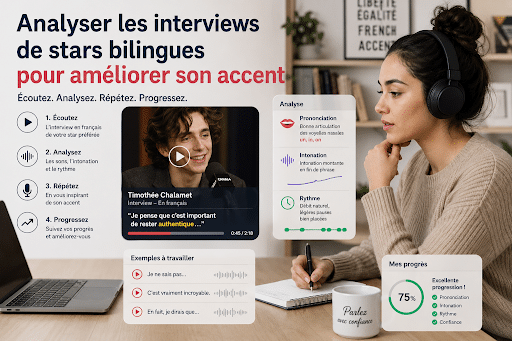
First technique: active imitation. Pick an interview of a bilingual star whose accent you admire. Listen to a sentence. Pause. Repeat. Not by reading, but by listening. The goal isn’t to understand what’s being said (you probably already do) but to reproduce the exact sound, the rhythm, and the intonation. This is what actors call “shadowing,” and it’s one of the most effective methods for improving an accent.
Second technique: observe the mouth. On YouTube, switch to full screen and watch how the person shapes each sound. English, for instance, uses a lot more jaw movement than French. French calls for lips to be in a more rounded and closed position. If you try speaking French with your mouth wide open in an American style, your accent will reveal itself immediately.
Third technique: combine observation with structured practice. Interviews give you the model, but to systematically correct pronunciation errors you need a tool that listens to you and offers corrections. An online language course with integrated speaking practice is ideal for this. Promova, for example, is a language-learning app for people who want to speak, not just read. It combines structured learning with AI-assisted speaking practice, allowing you to work on troublesome sounds in simulated conversations and receive precise feedback.
Which Celebrities to Study Depending on Your Target Language
If you’re focusing on English, interviews with Marion Cotillard, Léa Seydoux, or Tahar Rahim while promoting in Hollywood are a treasure trove. Cotillard has a light but very precise accent, making her an excellent model for Francophones who want to be understood clearly without losing their distinctive vocal identity. Seydoux has a more restrained style, with slightly longer pauses that give her time to formulate. Rahim, on the other hand, shows a remarkable progression from interview to interview, which is encouraging for anyone who feels discouraged by their own accent.
For those learning French, American celebrities’ interviews in France are just as instructive. Jodie Foster, who speaks nearly flawless French, serves as a pronunciation model for English speakers. Timothée Chalamet, raised bilingual, offers an example of switching between two accents that demonstrates how consistent practice makes a difference. Culture Ministry data indicate that only 31% of metropolitan French residents report mastering English, which shows there’s still progress to be made, even in a country as exposed to English as France.
How to Structure Your Progression
Don’t scatter your efforts. Pick a star whose accent you like and focus on her for several weeks. Watch her interviews in chronological order, and you’ll often see a progression: early international appearances are hesitant, speech is slow, the accent is more pronounced. Over the years, everything tightens. Watching this evolution is motivating because it proves that accent work pays off, even for professionals.
Record yourself. It’s uncomfortable, but essential. After mimicking a line from your model star, listen to your own recording and compare. You’ll notice differences you don’t hear when you’re speaking in real time. The brain filters many things when you’re concentrating on producing a sentence. It’s by listening back that you identify the real points to improve.
Focus on one sound at a time. If the English “th” gives you trouble, find passages where your model star uses a lot of “th” and repeat only those portions. If it’s the French “r,” seek out interviews where the person says words like “vraiment,” “très,” or “regarder.” Targeted practice yields faster results than broad repetition.
Beyond Imitation
Imitating bilingual celebrities is an excellent starting point, but it’s not a complete method. You also need to understand the phonetic rules behind what you hear, practice across varied contexts, and get feedback on your own mistakes. Lifestyle and trend-driven apps show that personal development is all the rage, and language learning is a full participant in that movement.
The key is to make practice regular and enjoyable. If you enjoy staying on top of celebrity news, you already have an endless supply of instructional material at your fingertips. Each interview becomes a free pronunciation lesson, provided you listen with the right ears.
Bilingual stars weren’t born with perfect accents. They built theirs, interview after interview, role after role, conversation after conversation. What sets them apart isn’t innate talent for languages. It’s consistent, targeted, and sustained practice over time. You have access to the same tools they do. The only thing missing is regularity. And that, is completely in your hands.
Karla Miller RADIO
LIVE