

From January to September 2026, the monitored bookings rose compared to the same period in 2025, while the share completed within the time limits grew by 1.7 percentage points for both first visits and examinations. Still, more than 4 million bookings remain out of the maximum allowed time.
This is the finding of an independent analysis by the GIMBE Foundation on the monitoring of 14 types of first visits and 22 groups of tests, based on data from the AGENAS Bulletin n. 1 and the public dashboard of the National Waiting Lists Platform (PNLA).
“The new Agenas data on waiting lists – says Nino Cartabellotta, president of the GIMBE Foundation – show some signs of improvement, but the picture remains critical: more than 4 million bookings are still overdue. Moreover, the data do not allow us to determine how many procedures were actually delivered within the time frames, nor reconstruct the citizens’ total waiting—from prescription to delivery.”
Bookings rising, limited improvement in performance
Monitored bookings rise from 19.75 million in 2025 to 21.81 million in 2026 (+10.4%): 12.27 million first visits (+8.3%) and 9.54 million tests (+13.3%) (Table 1).
Table 1. Monitored bookings
(GIMBE analyses based on the AGENAS Bulletin and the National Waiting List Platform)
| Bookings | Gen-Jan 2025 | Gen-Jan 2026 | Change | Change % |
| First visits | 11,327,076 | 12,267,214 | +940,138 | +8.3% |
| Tests | 8,419,374 | 9,541,506 | +1,122,132 | +13.3% |
| Total | 19,746,450 | 21,808,720 | +2,062,270 | +10.4% |
The share completed within the time frames rose from 76.9% to 78.6% for first visits and from 83.3% to 85% for examinations (Figure 1).
From the 2.03 million additional on-time bookings, 81.5% is tied to the overall volume growth (+1,657,201), and only 18.5% to the improvement in the on-time share (+375,414) (Figure 2).
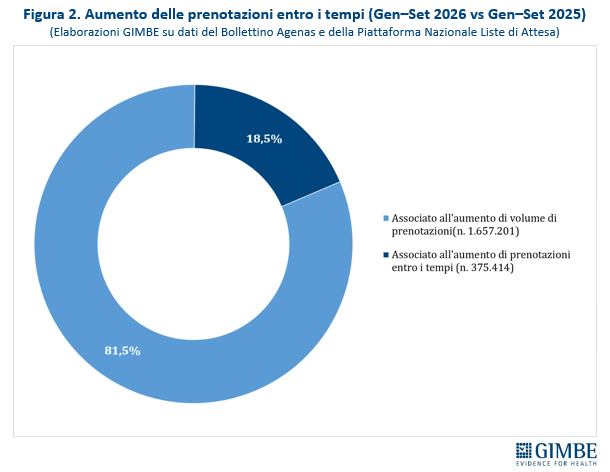
“Having more appointments offered within the time frames – Cartabellotta comments – is a positive result, but it does not equate to catching up on delays. Most of the increase is due to higher volumes, while less than a fifth is attributable to improved performance. A crucial distinction to avoid conflating more bookings with shorter waiting times.”
Over 4 million bookings outside the time window
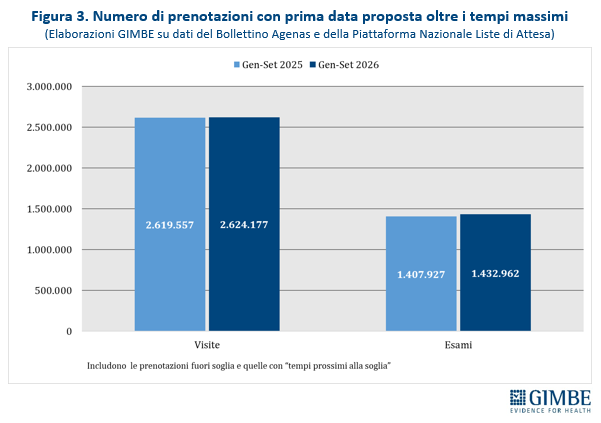
Including bookings with times close to the guarantee threshold, those overdue exceed 4,057,139, versus 4,027,484 in 2025 (+0.7%): 2,624,177 first visits, or 21.4% of the total, and 1,432,962 tests, or 15% (Figure 3). The overall share drops from 20.4% to 18.6%, but the absolute number does not decrease due to the overall rise in bookings.
Urgencies and short-priority: about one in five bookings is late
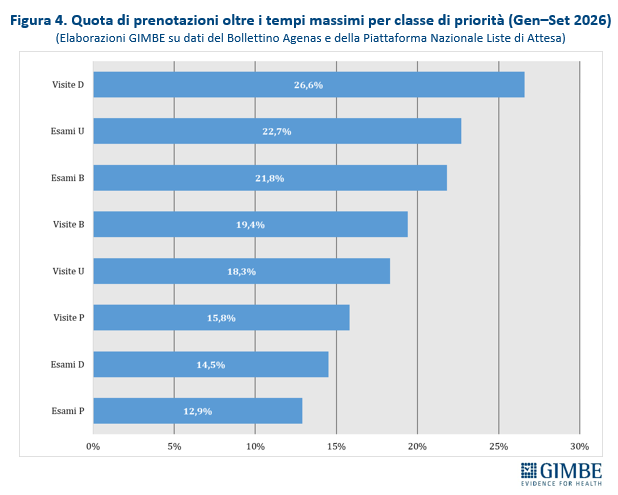
For urgent procedures, to be completed within 3 days, the overdue share remains at 19.5% of bookings: 18.3% of first visits and 22.7% of tests. For short-priority, within 10 days, more than 1 in 5 tests and about 1 in 5 visits are overdue. Among postponable first visits, 30 days out, 26.6% are overdue, compared with 14.5% of tests (Figure 4).
The PNLA also notes that for 5.1% of urgent tests, the first available slot is proposed at least 31 days after contact with the CUP, compared with the 3 days expected; for 8.3% of postponable visits, at least 121 days, versus the 30 days planned.
Foregoing health care services
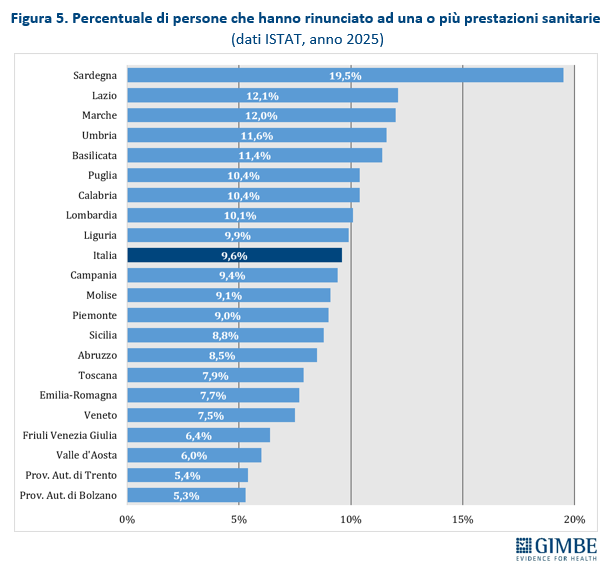
According to ISTAT’s BES 2026 Report, in 2025 9.6% of the population, more than 5.6 million people, forwent at least one medical visit or diagnostic test despite needing it. Long waiting lists are the most common reason for skipping (6.5%), followed by costs (5.2%). The share peaks at 19.5% in Sardinia, 12.1% in Lazio, and 12% in Marche; the lowest rate is in the autonomous province of Bolzano (5.3%) (Figure 5).
First visits and diagnostic tests
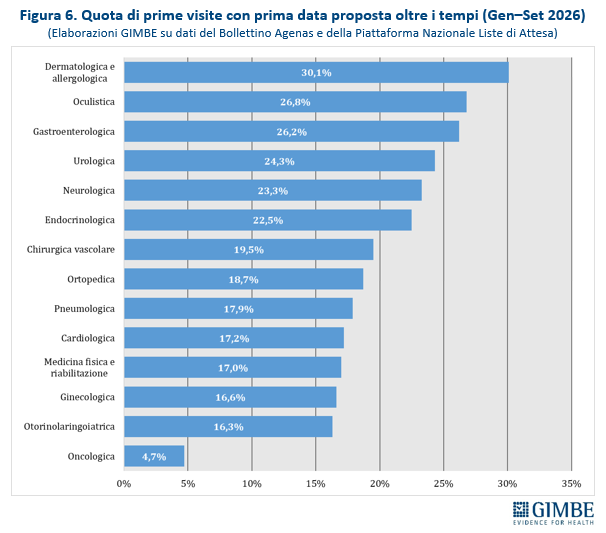
The share of on-time bookings improves for 13 of the 14 types of first visits. The largest gains are in dermatology and allergology (+4.1 percentage points), physical medicine and rehabilitation (+3.7), gastroenterology (+2.6), and pulmonology (+2.4). Only orthopedic visits worsen (−0.2 percentage points). Still overdue are 30.1% of dermatology and allergology visits, 26.8% of eye examinations, and 26.2% of gastroenterology visits (Figure 6).
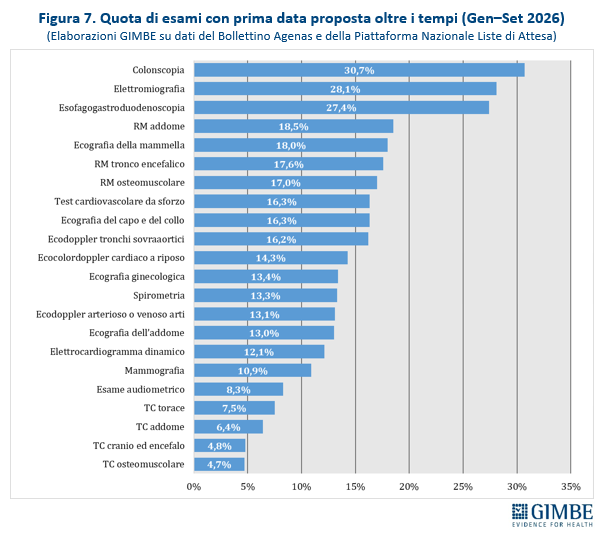
For diagnostic tests, the on-time share improves in 20 of the 22 monitored types. The biggest gains are in colonoscopy (+6.5 percentage points), gastroscopy (+4.0), and breast ultrasound (+3.7). Deteriorations occur in the brainstem MRI (−2.4) and the musculoskeletal MRI (−0.4). Still overdue are 30.7% of colonoscopies, 28.1% of electromyographies, and 27.4% of gastroscopies (Figure 7).
In the first nine months of 2026, among 2,839 urgent colonoscopy bookings, for 1,845 (65.0%) the first offered slot exceeds the three days anticipated.
Regional comparisons to be interpreted with caution
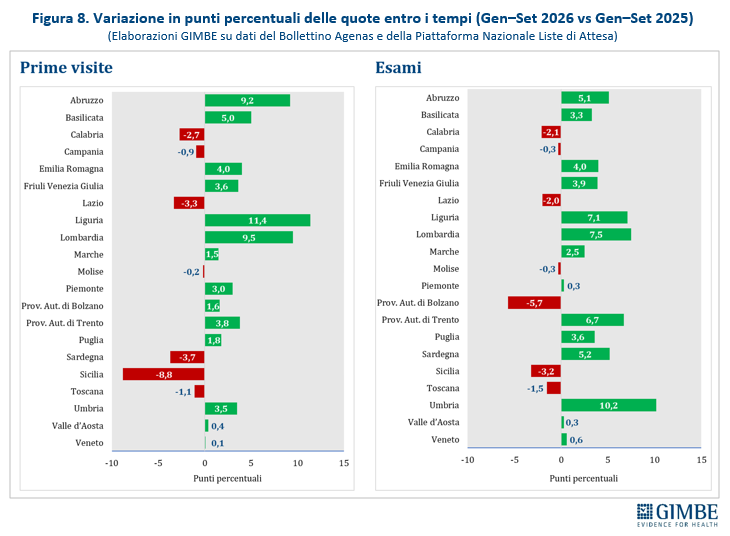
Calabria, Campania, Lazio, Molise, Sicily, and Tuscany show worsening in the share of bookings within the time frames for both first visits and tests. Sardinia worsens for visits and the Autonomous Province of Bolzano for tests (Figure 8).
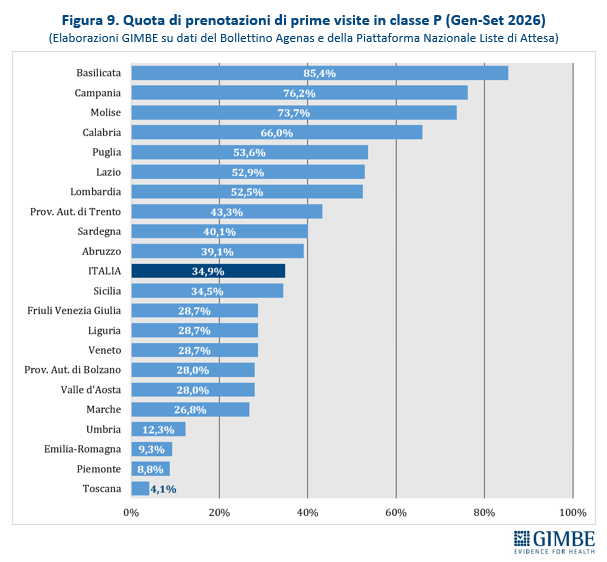
AGENAS notes a strong variability in assigning priority class P for first visits: from 4.1% in Tuscany to 85.4% in Basilicata, with a national average of 34.9% (Figure 9). The different distribution of priorities and the mix of procedures can therefore make regional comparisons based on aggregated data misleading.
The data measure the proposed wait, not the actual delivery
PNLA and Bulletin indicators measure the time from the CUP contact to the first proposed date: ex-ante monitoring. They do not document the actual delivery of the service, which requires ex-post monitoring, nor the time between prescription and first CUP contact or requests that do not become bookings (Figure 10).
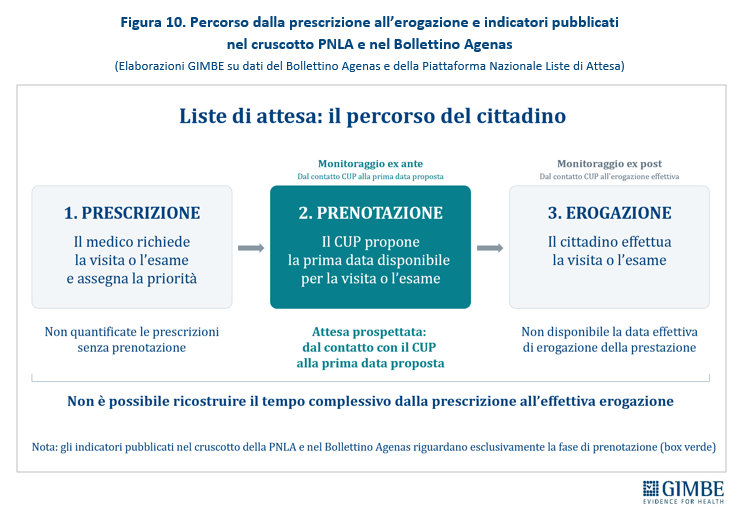
According to the data from the Sistema Tessera Sanitaria cited by AGENAS in its May 29, 2026 note, in 2025 only 50.3% of prescriptions for first visits and 54.4% of prescriptions for diagnostic tests were followed by a CUP booking.
“An appointment proposed – emphasizes Cartabellotta – is not a service delivered, and an increase in bookings does not prove higher productivity. To verify actual waiting times for citizens, it is essential to connect prescriptions, proposed and accepted appointments, and services delivered, and to reveal what happens to those who cannot book.”
“With the platform for waiting lists – concludes Cartabellotta – the National Health Service has taken a crucial step toward transparency, essential for understanding and governing access to health services. However, the public data measure only a portion of what citizens wait for: to make the platform truly useful, Agenas should make data openly available for reuse, at least by procedure, priority class, region, and health authority. It is also necessary to reconstruct the entire citizen journey, from prescription to delivery, and know how many requests never become bookings and for what reasons. Public trust is built on transparency that goes beyond proposed appointments and documents not only the proposed dates but the services actually delivered and the requests that never reach booking.”
Abbonati a Karla Miller